
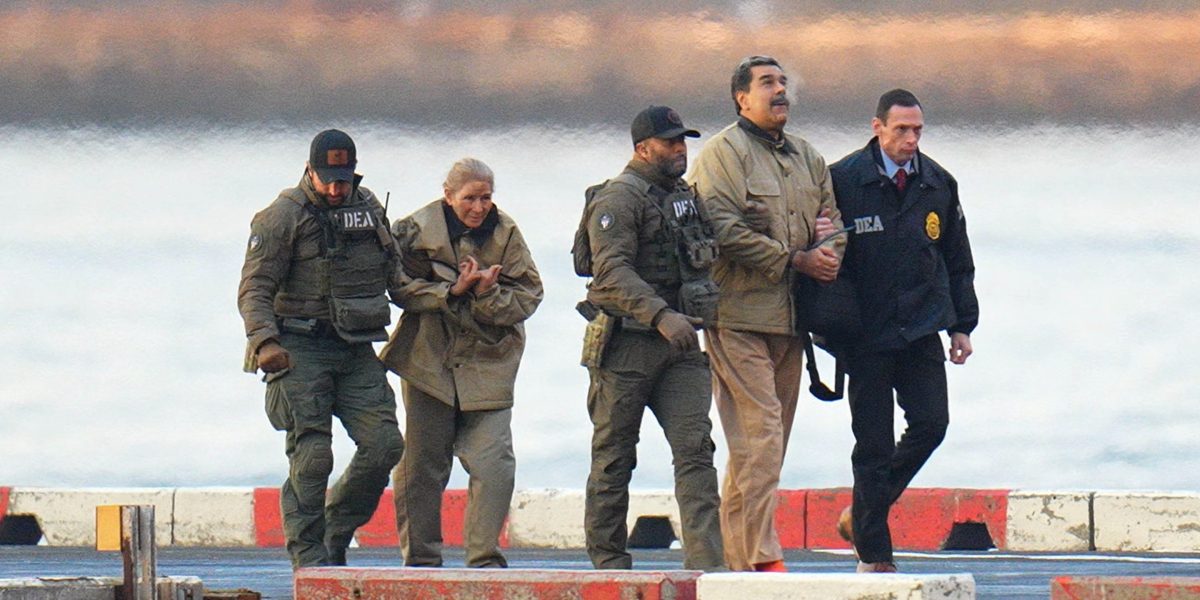

The Trump administration’s move is no accident; it reflects a broader trend in U.S. foreign policy that I described here almost six years ago as “american bully“.
Washington increasingly relies on coercion – Military, economic and political – not only to deter adversaries; force weak countries to comply. This may lead to short-term compliance but is counterproductive as a strategy for building lasting power, which depends on legitimacy and competence. When coercion is applied to governance, it can intensify resistance, narrow diplomatic options, and turn local political failures into contests of national pride.
But removing a leader—even a brutal and incompetent one—is not the same as advancing a legitimate political order.

Force does not equal legality
by declaring its Intention to govern VenezuelaThe United States is creating a governance trap of its own making—a trap in which external forces are mistakenly viewed as substitutes for domestic legitimacy.
I write as International security and civil war scholar and U.S. foreign policy, and as thedie by swordexplores why countries repeatedly seek military solutions and why such interventions rarely lead to lasting peace.
The core finding of the study is simple: force can overthrow rulers, but it cannot generate political authority.
when violence and what i have Described elsewhere as “kinetic diplomacy”” becomes a substitute for action across the full spectrum—which includes diplomacy, economics, and what the late political scientist Joseph Nye called “soft power”—it tends to deepen instability rather than resolve it.
More force, less statecraft
Events in Venezuela reflect a broader shift in the way the United States uses power. My co-author Sidita Kushi and I documented this by analyzing detailed data from new research military intervention project. We show that since the end of the Cold War, the United States has dramatically increased the frequency of military intervention while systematically reducing its investment in diplomacy and other tools of statecraft.
A striking feature of the trends we found was that Americans tended to justify excessive military intervention during the Cold War from 1945 to 1989 because they believed that The Soviet Union was an existential threatwe expect much less military intervention After the collapse of the Soviet Union in 1991. But that didn’t happen.
Even more strikingly, the mission profile has changed. Interventions once aimed at short-term stability now often extend to long-term governance and security management, as they did in both countries Iraq after 2003 and Afghanistan after 2001.
Institutional imbalances reinforce this pattern. By 2026, for every dollar the United States invests in the State Department’s diplomatic “scalpel” for conflict prevention, it will invest $28 in the Department of Defense’s military “hammer,” effectively ensuring that force becomes a means. first resort not last resort.
“Kinetic Diplomacy” In the case of Venezuela, regime change through force became the default approach, not because it was more effective, but because it was the only tool of statecraft immediately available. On January 4, Trump told The Atlantic Monthly that if Delcy RodriguezActing leader of Venezuela,”If she doesn’t do the right thing, she will pay a big pricepossibly bigger than Maduro. “
Lessons from Afghanistan, Iraq and Libya
The consequences of this imbalance have been evident over the past quarter century.
In Afghanistan, U.S.-led attempts to forge authority solely through external forces are inherently fragile. The United States was Invasion of Afghanistan in 2001 to overthrow the Taliban The regime was held responsible for the 9/11 terrorist attacks. But then two decades of foreign-supported state-building Collapse almost immediately after U.S. forces retreated 2021. No amount of reconstruction spending can make up for the absence of a political order rooted in domestic consent.
After the U.S. Invasion 2003 Iraqi armed forces surrenderAfterwards, both the U.S. State Department and the Department of Defense proposed plans for Iraq’s transition to a stable democracy. President George W. Bush approves Defense Department plan.
Unlike the State Department’s plan, this plan ignored key cultural, social, and historical conditions. Instead, it proposes an approach that assumes that a credible threat using coercion, supplemented by private contractors, will prove sufficient to cause Quick and efficient transition Towards a Democratic Iraq. The United States is responsible not only for security, but also for power, water, jobs, and political reconciliation—tasks that no foreign power can accomplish without becoming, Like the United States, became an object of resistance.
Libya exhibits a different pattern of failure. There, Intervention by U.S.-backed NATO forces After the overthrow of dictator Muammar Gaddafi and his regime in 2011, there was no governance at all. The result was civil war, secession, militia rule and long struggle Sovereignty and economic development continue to this day.
What these three cases have in common is hubris: the belief that American governance—whether limited or oppressive—can supersede political legitimacy.
Venezuela’s infrastructure is in ruins. If the United States took responsibility for governance, every blackout, every food shortage, and every bureaucratic failure would be blamed on it. The liberators will soon become the occupiers.
Governing in Venezuela also carries broader strategic costs, even if they are not the main reason for the strategy’s failure. A combination of military attacks and foreign governments can disrupt Sovereignty and the principle of non-interference It is the foundation of the international order that the United States claims to support. It complicates alliance diplomacy by forcing partners to reconcile U.S. actions with rules they are trying to defend elsewhere. The United States has The strongest in history At the time it established an open realm based on cooperation with allies, shared rules and voluntary alliances. Launching military action and then assuming governance responsibilities would shift Washington toward a closed, coercive model of power—one that relies on force to establish authority and is costly to maintain over time. These signals are read not only in Berlin, London and Paris. They are closely watched in Taipei, Tokyo and Seoul, as well as in Beijing and Moscow. When the United States attacks a sovereign nation and then claims the right to govern that nation, it undermines its ability to counter rival arguments that power alone, rather than legitimacy, determines political authority. Beijing only needs to point to U.S. behavior to demonstrate that a great power can rule as it pleases — an argument that could justify taking over Taiwan. Likewise, Moscow could cite such precedents to justify the use of force in foreign countries nearby And not just in Ukraine. This is important in practice, not theory. The more the United States normalizes unilateral governance, the easier it will be for adversaries to view U.S. claims to sovereignty as selective and selfish, and the harder it will be for allies to justify their relationships with the United States. This erosion of credibility will not cause a serious rupture, but it will gradually shrink the space for cooperation over time and as U.S. interests and capabilities advance. Power is fast. Legality has been slow to come. But legitimacy is the only currency that can buy lasting peace and stability—both of which remain in America’s enduring interests. If Washington rules Venezuela by force, it will repeat the failures of Afghanistan, Iraq, and Libya: power can overthrow regimes but cannot create political authority. External rules create resistance, not stability. Monica Duffy ToftProfessor of International Politics and Director of the Center for Strategic Studies at the Fletcher School, Tufts University This article is reproduced from dialogue Licensed under Creative Commons. read Original article.
The cost of “managing” a country
