


Good morning. New research shows that many boards are approving AI strategies without a clear understanding of whether underlying controls are actually effective, putting CFOs at risk when regulators, auditors or investors ask for evidence. In the private sector, health care appears to face the most serious challenges.
Technology security company Kiteworks has released its “Data Security and Compliance Risk: Forecast Report to 2026”, based on a survey of 225 security, IT, compliance and risk leaders across 10 industries and eight geographies.
One of the key findings is that 53% of organizations are unable to delete personal data once an AI model is used, creating long-term exposure to GDPR, CPRA and emerging AI regulations.
All respondents said agent AI is on their roadmap, but controls to manage these systems lag. Overall, 63% of enterprises are unable to enforce purpose restrictions on AI agents, 60% lack kill switch functionality, and 72% do not have a software bill of materials (SBOM) for the AI models in their environment. The result: AI systems are accessing, processing and learning from sensitive data without organizations being able to fully trace where the data is going or prove how it is being used, the report said.
Of the 10 industries surveyed, governments face the most significant challenges due to legacy systems. However, in the private sector, healthcare has clear weaknesses in control and AI governance.
Healthcare organizations are also among the most conservative in their AI spending. More than 80% of respondents said they currently have no plans for API agents, a technology that enables AI agents to connect with external systems and run in coordinated workflows. Kiteworks found that while careful deployment can reduce near-term risks, organizations that delay deployment may also fail to build the governance capabilities they need as the use of AI expands.
The caution reflects long-standing economic constraints. The healthcare industry lags behind industries such as banking and manufacturing in adopting advanced technologies, largely because of razor-thin operating margins. Report on Becker Hospital Review. However, industry leaders increasingly view AI as critical to financial sustainability. cleveland clinic Dennis Laraway, executive vice president and chief financial officer, told the publication that artificial intelligence, robotics and automation can help health systems scale by expanding patient coverage, increasing volume, and improving speed and accuracy to support cost transformation amid payment reform and regulatory pressures.
These competitive forces are landing directly on the desks of CFOs.
“As pressure to invest in AI intensifies, healthcare CFOs are navigating an extremely difficult balancing act,” Tim Freestone, chief strategy officer at Kiteworks, told me. “Unlike tech or retail, many health systems operate on 2% to 3% margins in good years, making every technology decision feel existential rather than experimental.”
Freestone added that quantifying the return on investment in AI remains particularly difficult. “How do you put a monetary value on faster diagnoses or reduced clinician burnout?” At the same time, any AI deployment involving patient data comes with significant compliance and security costs, he said.
Freestone said that because the healthcare industry has been relatively slow to develop an AI governance framework, more CFOs are being asked to approve major investments in technologies that their organizations may not yet have the in-house expertise to evaluate or manage. “They are essentially being asked to build the aircraft at the same time as they decide whether to buy the aircraft,” he said.
As scrutiny shifts from AI ambition to AI execution, CFOs may find that governance, rather than innovation, becomes the real test.
Cheryl Estrada
sheryl.estrada@fortune.com
Ranking list
Ann Rice Appointed Chief Financial Officer green plains corp. (Nasdaq: GPRE) is a biorefinery company, effective January 6. Reis joins Green Plains from Southwest Iowa Renewable Energy, where he served as chief financial officer, chief accounting officer and assistant secretary to the board of directors. She has more than 20 years of experience, including leadership roles at Lincoln Financial Group and ConAgra Foods. Reis succeeds Phil Boggs, who has served in various financial leadership roles over the past 16 years. He left the company on January 5.
Spencer Hart Appointed Chief Financial Officer Loop Industries (NASDAQ: LOOP) is a clean technology company, effective January 15. Hart, who has been a member of Loop’s board of directors since February 2025, will transition to a full-time executive role. Hart will also continue to serve on the board of directors. He has more than 30 years of experience, most recently as Senior Managing Director and Senior Advisor at Guggenheim Securities.
event
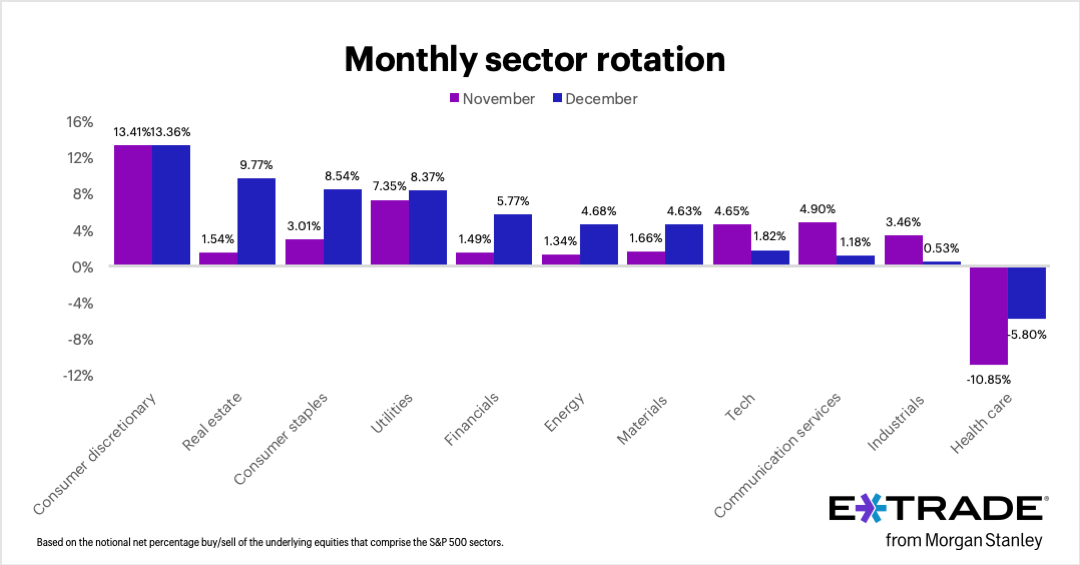
Morgan Stanley’s E*TRADE monthly analysis found the firm’s clients were net buyers of 10 of the S&P 500’s 11 sectors last month. The three most purchased sectors in December 2025 are consumer discretionary (+13.4%), real estate (+9.8%) and consumer staples (+8.5%). Chris Larkin, managing director of trading and investments, said that unlike in recent months, the data showed that clients were not actively moving in and out of the tech sector.
“While the shift toward consumer discretionary was already evident in November, net purchases in real estate, one of the weaker sectors last month, were more of a surprise,” Larkin said. “This likely reflects expectations of lower interest rates, which could provide momentum for these stocks going forward.” December also marked the third consecutive month that clients have been net sellers in health care, he added.
go deeper
“Trump’s attack on Venezuela gave the United States on paper 30% of the world’s oil reserves, but in reality $100 billion in reconstruction efforts” wealth article Authors: Sasha Rogberg and Nick Lichtenberg.
Excerpt from the article: “After decades of mismanagement and sanctions, the path to dominance, at least in the oil sector, will be an uphill battle, experts warn. State-owned oil giant Petroleos de Venezuela The collapse of the mid-2010s After losing foreign financial support and the skilled workers to maintain the pipeline. 2017, Trump’s first administration Oil sanctions escalate Venezuela, restricting the country’s access to the U.S. market. Oil companies’ efforts to increase production, such as rebuilding infrastructure, will take about a decade, said Helima Croft, head of global commodities strategy at RBC Capital Markets. ” Full article here.
overheard
“As we left the event, we felt even more bullish on Nvidia and the AI revolution as a whole because the next phase of investment and technology is coming.”
——Wedbush Securities analysts wrote in an industry report after attending Nvidia CEO meeting on Monday Jen-Hsun Huang’s keynote speech at CES In Las Vegas. yellow Unveiling Rubinthe company’s first extreme co-engineered six-chip AI platform, is now in full production, and Introducing Almayoa family of open inference models for autonomous vehicle development. This is part of “comprehensive promotion of artificial intelligence into various fields” According to the company.