
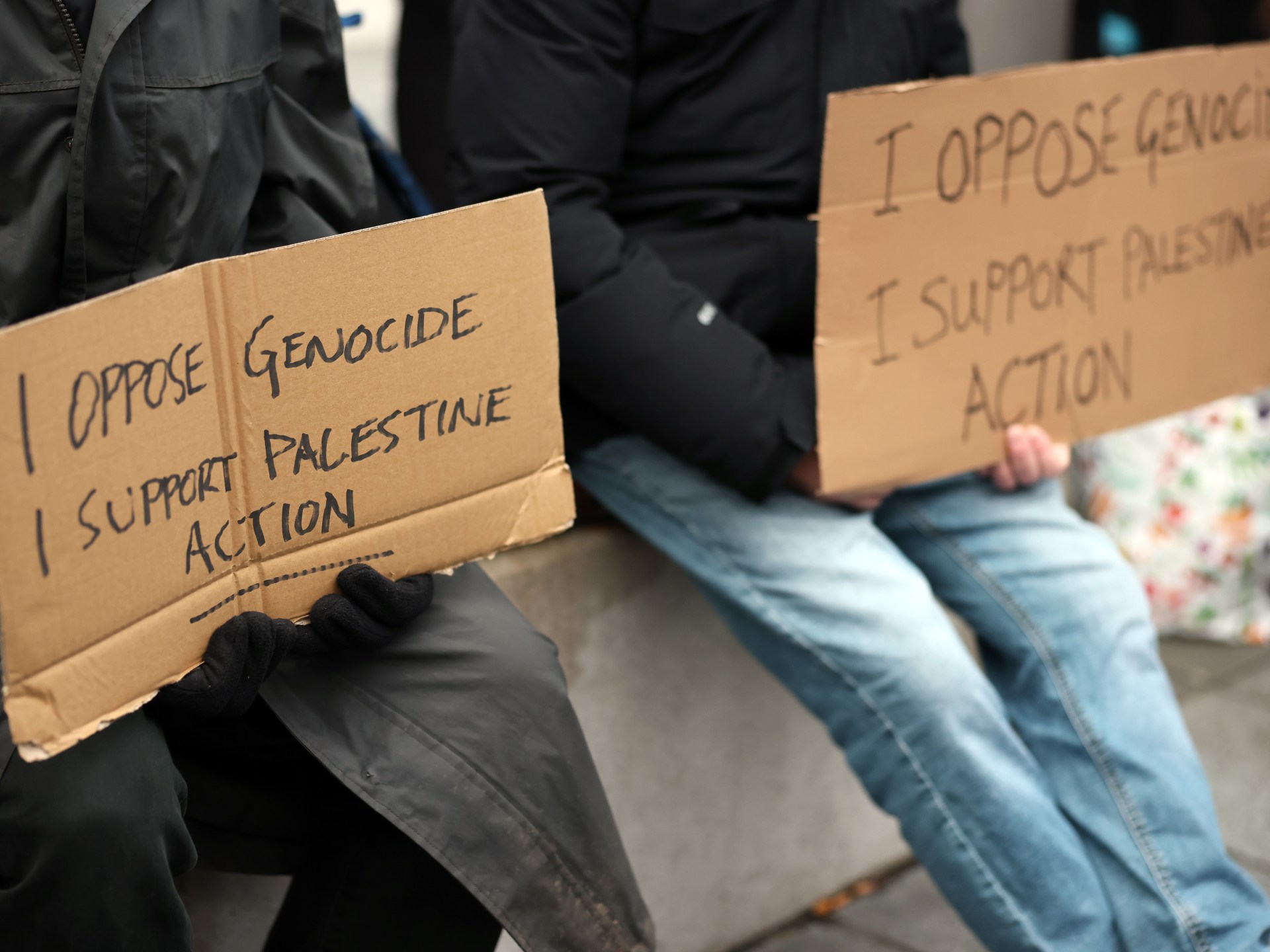

In June 2025, the UK government banned the UK-based group Palestine Action as a terrorist organization under the Terrorism Act 2000. This was not a security decision, but a political decision that marked an unprecedented increase in the criminalization of Palestine solidarity in the United Kingdom. Palestine Action members have taken non-violent direct action aimed at disrupting the UK’s involvement in the Gaza genocide, targeting facilities associated with Israel’s arms industry operating in the UK, including Elbit system sites and elements of British military infrastructure.
Rather than confronting its own actions, the government has sought to divert attention from the central issue: the UK’s role in the Gaza massacre. During Israel’s assault on Gaza, the UK has provided sustained political and diplomatic support, supplying components for F-35 fighter jets and conducting R1 surveillance flights over Gaza. Taken together, these actions make the British government not only complicit, but complicit in the violence itself.
At the same time, the UK has sought to obstruct international accountability. It has sought to interfere with proceedings at the International Criminal Court — whose conduct constitutes a crime under Article 70(1) of the ICC Statute — by intimidating the ICC Prosecutor and creating procedural obstacles designed to delay or prevent the issuance of arrest warrants against Israeli leaders. Instead of re-evaluating policies that face legal and ethical accountability, governments have turned to those who insist on holding on to their own commercial values – when geopolitically convenient, such as values in Ukraine and Greenland.
Anti-terrorism laws to support political imprisonment
Persecution of individuals for political reasons through the law is nothing new. As early as 399 BCE, Socrates was put on trial in Athens and charged with “lawlessness”, “not recognizing the gods recognized by the state” and “corrupting the youth” as an instrument of oppression.
Today, Russia’s crackdown on dissent, formally legal, is one of the contemporary examples of political imprisonment, regularly condemned by Western governments, including the UK.
Efforts to define and legally operationalize the concept of political imprisonment have long been resisted. While there is no consensus on what constitutes a “political prisoner” or a “prisoner of conscience”, the criteria established by the Parliamentary Assembly of the Council of Europe (PACE), of which the UK is a member, provide clear and authoritative guidance:
“a. If the arrest is imposed in violation of the fundamental guarantees set out in the European Convention on Human Rights and its Protocols (ECHR), in particular freedom of thought, conscience and religion, expression and information, assembly and association;
b if the arrest is made for purely political reasons without connection with any crime;
c if, for political purposes, the length of detention or its conditions are clearly disproportionate to the crime for which the person has been convicted or suspected;
d if, for political purposes, he or she is detained in a discriminatory manner compared to other persons; or,
e If the detention is the result of proceedings which are manifestly unjust and appear to be related to the political motives of the authorities. (SG/Inf(2001)34, paragraph 10).
These criteria relate directly to the UK’s Palestine action. The British government is complicit in Israel’s systematic unmaking of Palestine, including its illegal occupation, its system of apartheid and its role in the Gaza genocide, and Palestine Action has directly challenged this complicity. Where public order and civil disobedience laws failed to suppress this activism, the state resorted to exceptional anti-terrorism legislation.
The government has since adopted the Terrorism Act to criminalize activists and sentence them to prison terms of up to 14 years, a level of punishment disproportionate to non-violent direct action. This disparity and choice of law reflect political motives.
The Non-Violent Direct Action on Terrorism Act of 2000 deprives activists of normal legal protections and subjects them to an exceptional penal regime, including extended pre-trial detention, enhanced surveillance powers, restrictions on association and expression, and dramatically increased sentence exposure. Such measures are generally reserved for acts of mass violence, not protests aimed at preventing harm.
According to the PACE criteria, detention can be considered political where the punishment is clearly disproportionate or where legal proceedings are unfair and politically motivated. Here, non-violent activism faces the prospect of long imprisonment along with the destruction of reputation through terrorist designation. This combination satisfies several indicators of political imprisonment, particularly criteria (c) and (e).
Using anti-terrorism law in this context does not merely criminalize the conduct; It itself redefines dissent as a security threat, presupposes just judgment, and conditions the public to accept extraordinary punishment for ordinary political opposition.
The wider picture
In penology, the penal system can serve a number of recognized purposes, including mere desertion and retribution, incapacitation and deterrence. What is happening in the UK does not fit either of these aims. Instead, the penal system is being deployed to expand executive power and suppress political opposition, deviating from the purpose it should serve in a liberal democracy.
The UK is complicit in serious breaches of international law and has not only failed to meet its international legal obligations, but has actively breached them. Some British citizens concerned with justice, international law and human rights have stepped up peacefully to challenge their government’s wrongdoings. The state’s response is to criminalize dissent while presenting repression as democratic self-defense.
Let us be clear: Declaring Palestine Action a terrorist organization is not an isolated act. It is part of the UK’s wider complicity in Israeli oppression and genocide, and it works domestically to silence those who seek to disrupt this complicity.
This is not the first attempt to legislate in the UK to support Israel’s policies in Palestine. The introduction of the IHRA definition of anti-Semitism was another such attempt to control and intimidate opposition through legal means. By weaponizing anti-terror laws, the UK government has taken another step towards reducing the space for dissent.
The exceptional selectivity of legal instruments and the disparity of the chosen penal regime cannot be justified when measured against the behavior in question: nonviolent activism that aims to force governments to stop violence and uphold the international legal obligations they claim to champion. Those who participate in violence are calling non-violent people as terrorists.
Finally, it is shocking that after all these decades, the UK continues to ignore its unique historical responsibility towards the Palestinians. The UK imposed its mandate on Palestine by force, systematically privileging colonial and settler interests while governing the territory, before abdicating its responsibility and unilaterally withdrawing. This withdrawal was crucial in creating the circumstances in which the Naqba was revealed, in breach of the UK’s obligations under the mandate.
Among those obligations was the 1939 White Paper commitment to establish a Palestinian state within 10 years, which was never honored. The UK planted the seeds of Palestinian misery and then withdrew from Palestine without securing political self-determination for its indigenous people, leaving a legacy of dispossession that continues to shape the present.
More than a century after the mandate, it remains the Palestinians – supported by allies around the world – who are risking everything to defend the values of humanity and the principles of international law. In contrast, the British state has chosen evasion and suppression of accountability over accountability.
Any hope?
There is hope in rejecting the normalization of this moment. By challenging the ban on Palestine Action, activists are not only opposing the UK’s complicity in Israel’s crimes, but defending their own space of dissent. The struggle is not just to reverse a decision but to prevent the erosion of democratic limits through abuse of law. In the UK at present, defending democracy and acting against complicity in Israeli atrocities go hand in hand.
The views expressed in this article are the author’s own and do not reflect the editorial position of Al Jazeera.