

The US says it is lifting sanctions on Belarusian potash in the latest sign of a thaw between Washington and the isolated autocracy.
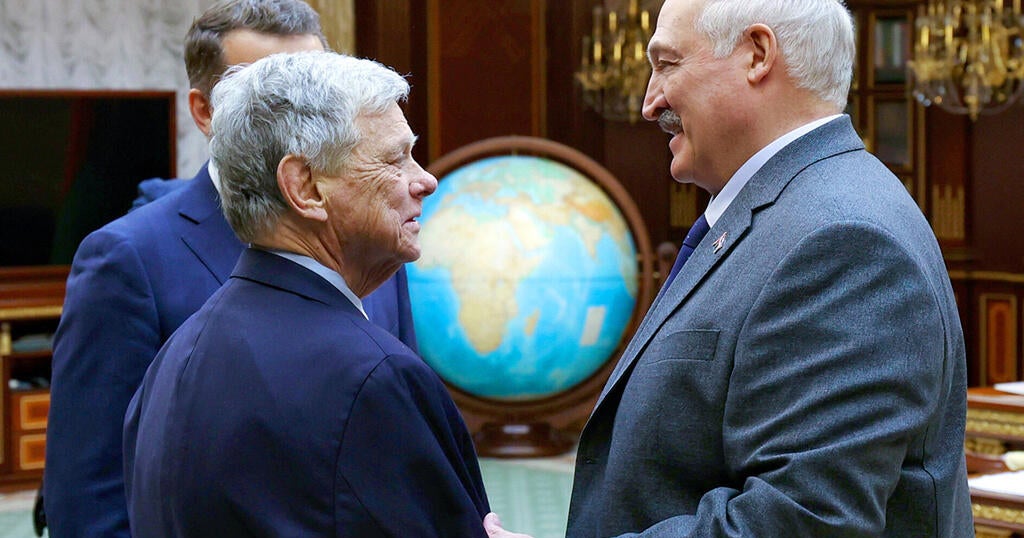
US Special Envoy to Belarus John Coale made the announcement after meeting with the country’s authoritarian leader, Alexander Lukashenkoin the Belarusian capital of Minsk on Friday and Saturday.
A close ally of Russia, Minsk has suffered years of isolation and sanctions from the West. Lukashenko has ruled the nation of 9.5 million with an iron fist for more than three decades, and the country has been. Punished repeatedly by Western countries both for the crackdown on human rights and for allowing Moscow to use its territory in the 2022 invasion of Ukraine.
Speaking to reporters, Coal described the two-day talks as “very productive”, the Belarus state news agency said on Saturday.
Press Service of the Presidency of Belarus via AP 
The US envoy said normalizing relations between Washington and Minsk is “our goal”.
“We are lifting the sanctions, releasing the prisoners. We are constantly talking to each other,” he said according to Belta. He also said that the relationship between the countries is moving from “small steps to more secure steps”, as the dialogue increases.
The last time US officials met with Lukashenko in September 2025, Washington announced the easing of some sanctions against Belarus while Minsk released more than 50 political prisoners in Lithuania. Overall, Belarus released more than 430 political prisoners since July 2024 in what was seen as an effort to reach a rapprochement with the West.
Belarusian opposition leader Sviatlana Tsikhanouskaya told The Associated Press on Saturday that the easing of sentences was part of a deal between Minsk and Washington in which another large group of Belarusian political prisoners was expected to be released.
“Releasing political prisoners means that Lukashenko understands the pain of Western sanctions and wants to ease them,” said Tsikhanouskaya.
And he added: “But let’s not be naive: Lukashenko has not changed his policy, his repressions continue and he continues to support Russia’s war against Ukraine. Therefore, we must be very careful to talk about easing sanctions, strengthening Russia’s war machine and constantly promoting repressions.”
Tsikhnouskaya also said that European Union sanctions against Belarusian potash fertilizers are far more painful for Minsk than those imposed by the US, and that while easing US sanctions could lead to the release of political prisoners, European sanctions should encourage long-term systemic changes in Belarus and an end to Russia’s war in Ukraine.
Recent discussions have also touched on Venezuela, as well as Russia’s ongoing invasion of Ukraine, Belta said.
Coal told reporters that Lukashenko had given him “good advice” on how to deal with the conflict, adding that Lukashenko and Russian President Vladimir Putin were “long-time friends” with “the necessary level of contact to discuss such issues”.
“Of course, President Putin may accept some advice and not some,” Coal said.