
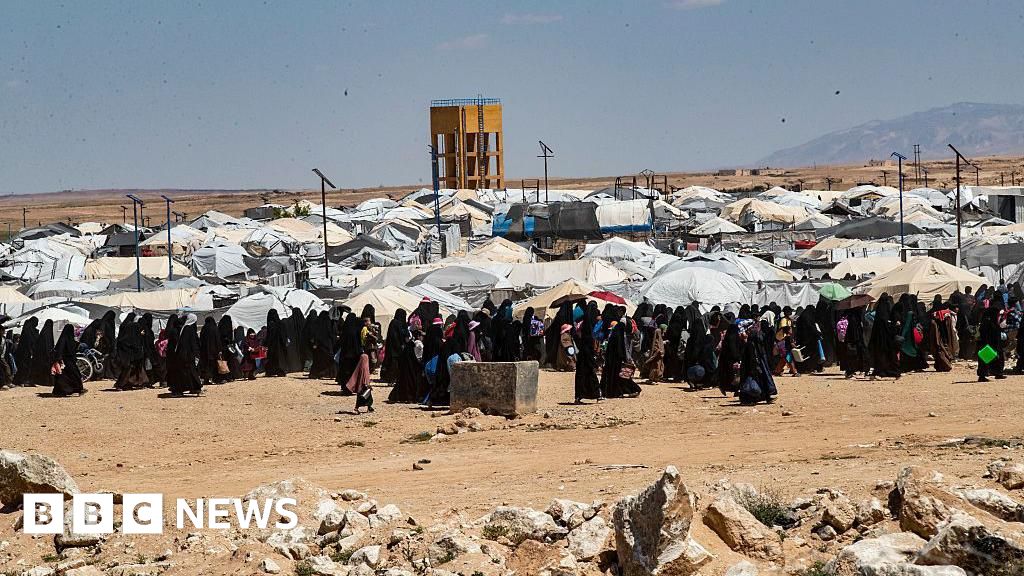

The Kurdish-led Syrian Democratic Forces (SDF) says it has withdrawn from a camp holding thousands of people with alleged links to the jihadist group Islamic State (IS), as fighting with the Syrian government continues despite a ceasefire agreement.
The SDF said its forces were “forced to withdraw” from al-Hol camp and redeploy to other cities in northern Syria “due to international indifference to the issue of (IS)”.
Syria’s interior ministry condemned the move, saying it happened without coordination with the government or the US-led coalition against IS.
This happened after several suspected IS fighters escaped from the nearby Shaddadi prison during clashes between government forces and the SDF.
On Sunday, the militia alliance agreed to give the government control of the autonomous Kurdish-run region in the northeast, including its prisons and camps, in a deal aimed at ending nearly two weeks of fighting.
The agreement also states that tens of thousands of SDF fighters will withdraw from Raqqa and Deir al-Zour provinces to nearby Hassakeh, and then be integrated as individuals into the defense forces and interior ministries.
It represents a major blow to the SDF, which has been reluctant to give up the autonomy it won for Syria’s Kurdish minority when it helped US-led coalition forces defeat IS militarily during the country’s 13-year civil war.
President Ahmed al-Sharaa has vowed to reunify Syria since he led the rebel offensive that toppled Bashar al-Assad in December 2024, but the country remains deeply divided and rocked by waves of deadly sectarian violence.
The SDF announced that its fighters withdrew from the al-Hol camp on Tuesday afternoon as the Syrian army and interior ministry forces advanced into Hassakeh province, after taking control of Deir al-Zour and Raqqa.
“Due to the international indifference to the issue of the IS terrorist organization and the failure of the international community to assume its responsibilities to solve this serious matter, our forces were forced to withdraw from al-Hol camp and redeploy around the cities of northern Syria facing increased risks and threats,” said a statement.
In a statement sent by the Kurdish Hawar news agency, SDF commander Mazloum Abdi urged the US-led coalition forces – once his main ally – to “bear its responsibilities to protect the facilities”.
“We are withdrawing from the predominantly Kurdish areas and protecting them is a red line,” he added.
The Syrian interior ministry said that the SDF units left al-Hol without any coordination in an “attempt to pressure the government to fight against terrorism”.
The ministry added that it “takes all necessary measures of coordination and cooperation with the international coalition to maintain security and stability”.
The defense ministry also said it was ready to take control of the camp as well as all prisons holding suspected IS fighters in the region.
Before fighting broke out with the government earlier this month, the SDF held about 8,000 suspected IS fighters in prisons in northeastern Syria.
About 34,000 people linked to IS are also being held in al-Hol and another camp, Roj, the UN reported in August. The population of the camps, of which 60% are children, consists of 6,700 Iraqis, 15,500 Syrians and 8,500 citizens of other countries, including the UK.
The SDF, the US and the UN have long called for the repatriation of foreign IS suspects and their families from northeastern Syria, citing political instability and dire conditions in prisons and camps, but many countries have refused to take them.
Earlier, the government and the SDF exchanged accusations over the escape of prisoners from an SDF-run prison in Shaddadi, in the southern province of Hassakeh, where up to 10,000 suspected IS fighters are being held.
The interior ministry said early Tuesday that its special forces and army soldiers entered the city after “the escape of around 120 (IS) terrorists” from prison.
Security forces conducted “targeted and systematic” search operations in and around the town, which resulted in the arrest of 81 of the fugitives, it added.
On Monday afternoon, the SDF said it had lost control of Shaddadi prison after “factions affiliated with Damascus” mounted a series of attacks and killed dozens of its fighters, saying it was trying to “prevent a serious security crisis”.
Later, SDF spokesman Farhad Shami said about 1,500 IS members escaped during the clashes, according to Reuters news agency.
The SDF also accused government forces of attacking al-Aqtan prison, north of Raqqa city, which holds IS members and leaders.
On Tuesday, a statement said the prison’s buildings and facilities were broken into and its water supply cut off.
“These acts constitute a flagrant violation of humanitarian standards and pose a serious threat to the lives of detainees,” it warned.
However, the defense ministry denied that there were clashes around the prison.
State news agency Sana quoted the ministry as saying the facility was “fully secured”, with military police and internal security forces deployed around it.
“The interior ministry continues to contact the administration of al-Aqtan prison to ensure that all necessary supplies are provided,” it added.
The US, once the SDF’s main ally in Syria, has not directly commented on al-Hol’s withdrawal or the clashes around the prisons.
However, special envoy Tom Barrack said the US is focused on ensuring the security of facilities holding IS prisoners and facilitating talks between the SDF and President Sharaa’s government to implement the ceasefire agreement.
“This opportunity offers a path to full integration into a unified Syrian state with rights of citizenship, cultural protection, and political participation – long denied under the regime of Bashar al-Assad, where many Kurds face statelessness, language restrictions, and systematic discrimination,” he wrote in X.
On Monday night, Sharaa’s office said she spoke by phone with US President Donald Trump to discuss developments in Syria.
The two leaders “stressed the importance of preserving the territorial integrity and independence of Syria” and “the need to guarantee the rights and protection of the Kurdish people within the framework of the Syrian state,” according to a Sana report.
Abdi’s statement on Tuesday emphasized the need for the government to “stop its attacks and return to the negotiating table”, according to Hawar.
He also asked Kurds around the world and friends in the region to “rally around the resistance of SDF fighters to ensure the protection of civilians”, it said.