
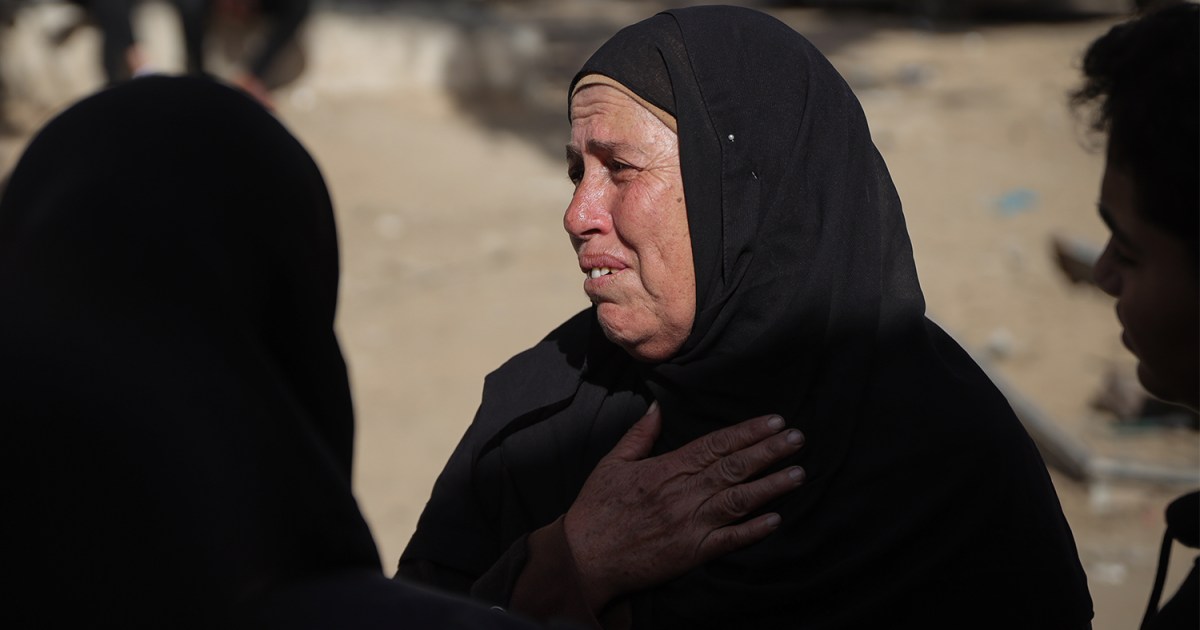

Gaza City, Gaza Strip – With weary steps and tearful eyes, Hana al-Mabuh moves between photographs of dead bodies and the morgue at al-Shifa Hospital to search for her missing son.
The 56-year-old mother wipes tears with the back of her hand and stares at the mutilated faces on the screen, torn by the desire to know what happened to her youngest son, while at the same time fearing that he may be among the dead in Israel’s custody. US-brokered cease-fire agreement.
Recommended stories
4 List of itemsEnd of list
Thousands of Palestinians in Gaza are searching for information about loved ones who have gone missing since the war began on October 7, 2023 following a deadly attack by Hamas.
Driven by her need for closure, Hana returns to scanning the images on the screen once more.
“This boy is a piece of me,” Hana tells Al Jazeera, referring to 18-year-old Omar, who disappeared with one of his cousins, Ala, last June when they went to inspect the ruins of their home in the Jabaliya refugee camp in northern Gaza. Omar, a high school student, was the youngest of his seven siblings.
“Every child is precious to his family, but my son is a part of me,” she added, tears streaming down her cheeks as she walked to the mortuary.
The family contacted the International Committee of the Red Cross (ICRC) and several human rights organizations to try to find out what happened to Omar and his cousin, but to no avail.
Hana says the wait was heartbreaking.
“We don’t know whether they are prisoners, or whether they (the Israelis) killed them and took their bodies, or whether they captured their bodies with the bodies they left in pieces.”
“It’s like we’re running through a mirage and we don’t know anything,” Hana said, as if trying to catch her breath.

endless search
Since Israel began returning Palestinian bodies to Gaza through the Karam Abu Salem (Kerem Shalom) crossing, Hana has become one of hundreds of family members shuttling between hospitals and reception points in search of any sign of the fate of their loved ones.
The latest batch of bodies arrived on February 4. Gaza’s health ministry said 54 bodies and 66 boxes containing human remains were released by Israel through the ICRC.
Here the remains arrived Al-Shifa Hospital In Gaza City, where medical and technical teams began preliminary examinations and documentation before presenting the families for possible identification.
Human rights organizations say transfers are carried out by the Red Cross in accordance with international rules, but the process does not always include detailed documentation or the circumstances of death, adding to the burden on Gaza authorities to sort through bodies and try to identify them within their limited ability to conduct DNA testing.
After the latest transfer, Hana visited the hospital several times to review the lists and photographs of the bodies.
“I didn’t leave any place without going there. I even went to Khan Yunus, south of the Strip, to check the photos,” she says.
The bodies were returned under a United States-brokered October 2025 cease-fire agreement between Israel and Hamas, in which the remains of 15 Palestinians would be exchanged for every Israeli body kept in Gaza.
As of last month, Israeli authorities have detained the bodies of more than 770 Palestinians who have been “Number and cemeteries of morgues“, according to the national campaign to recover the bodies of the martyrs and reveal the fate of the missing persons.
Hana’s suffering does not stop with revising Palestinian bodies. She also periodically checks lists of prisoners released by Israel, contacting the ICRC to try to confirm whether her son’s name appears.
“By God, the Red Cross remembers me and my voice, how many times I call and ask. They say to me: ‘Sister, weren’t you the one who called last time?’ I tell him: ‘Yes, my brother. I’m sorry, it’s not in my hands.’ He sympathizes with me,” she says.
Despite her best efforts, there is still no conclusive answer about her son’s future.
“As a mother, I want my son to be alive. But I prepare myself for the worst and this mental preparation has had no effect,” says Hana.
‘Why do they leave us lost?’
Hana says the hardest part is not just the loss, but the confusion and disorientation she lives in, with hundreds of other family members still searching for their relatives.
“Why do they leave us lost like this? We don’t know where they have gone or what their fate is,” she says.
Another serious matter is the “deplorable condition” in which the Israeli army has returned the bodies. “All the features are completely buried and I can’t even recognize my son’s features.”
Hana says she believes the mutilation is “deliberate” to add to the pain of Palestinian families. “It feels like they want to leave us in misery for the rest of our lives … to grieve endlessly for our children,” she says, tears streaming down her cheeks.
“My son was like a flower in his youth, when he disappeared. He was preparing to appear for his high school exams with his cousin. What did they do to disappear like this and not let us know their fate?”
Since the start of the war in October 2023, Fate of dead bodies The conflict with Israel has emerged as a central humanitarian and legal issue. Israel does not publish a consolidated list of the recognized institutions it has.
According to a statement from the Red Cross, it has “facilitated the transfer of 360 Palestinian bodies to Gaza since October 2023”, supported the handover of 195 Israeli detainees, including 35 dead, and the return of 3,472 Palestinian prisoners alive.
Only 99 returned Palestinian bodies have been positively identified, according to the Ministry of Health. The rest are unidentified or in the process of identification.
The ministry said some of the bodies had gunshot wounds to the head and chest, stab wounds, skull and limb fractures, in addition to advanced decomposition – greatly complicating forensic identification.

Appeal for international aid
Hana called on international organizations to intervene to help grieving families like hers to determine the future of their children.
“We cannot be calm or stable mentally or socially. We are under tremendous psychological pressure,” she says.
“They completely plowed the earth and excavated the graves looking for Israelite bodies with instruments and tests. But our children, no one asks about them. By what logic does this happen?”
In Gaza’s forensic department, a small team handles this heavy burden in situations that exclude the means of “certain confirmation”, leaving staff and families in a wide space of suspicion.
Ahmed Abu Taha, head of the bodies and missing persons files at the Ministry of Health, tells Al Jazeera that 120 bodies have recently arrived in Gaza via the ICRC. Some were complete, while others were just bone fragments and other human remains.
Only two of the 120 bodies were identified, and even those were scientifically inconclusive.
“Confirmatory” tests such as DNA analysis, forensic anthropology and forensic odontology are unavailable in Gaza’s destroyed health care system, meaning only “presumptive” testing can be conducted, which is less accurate, Abu Taha says.
“The steps start with a presumptive test – identifying specific features like distinctive marks, clothing, male or female, guessing age, amputations or tattoos… Then you move on to a confirmatory test. But unfortunately, in Gaza we only have a presumptive test.”
This type of testing “runs the risk of a lot of errors” including misidentification, he adds.

When error becomes tragedy
Most painfully, says Abu Taha, is the impact of the “mistake” on families desperately waiting to find the body of a missing child. Repeated mistaken identities have been reported, shocking many Palestinians and reopening wounds.
Abu Taha recounted a story that affected him deeply and illustrated the psychological and emotional toll families face in the absence of accurate DNA tests.
“On one occasion, members of a family came and identified a body as that of their son. They presented evidence that closely matched the body. The forensic team examined it and found similarities and indeed the body was handed over to the family.”
The bereaved relatives completed the formal process to receive the body, obtain the death certificate, then begin the cremation and burial. He announced a place to receive the mourners.
But there was a shock when, just two days after the burial, another family presented more conclusive evidence showing that the deceased was theirs.
Abu Taha says the disturbing phenomenon has been repeated in Gaza’s troubled hospitals.
He is calling for international intervention to pressure Israel to allow access to identification equipment and DNA testing tools as a moral and humanitarian matter to identify loved ones and end the suffering of families struggling to give them a proper burial.
“The body file is not just a numerical problem,” says Abu Taha.