
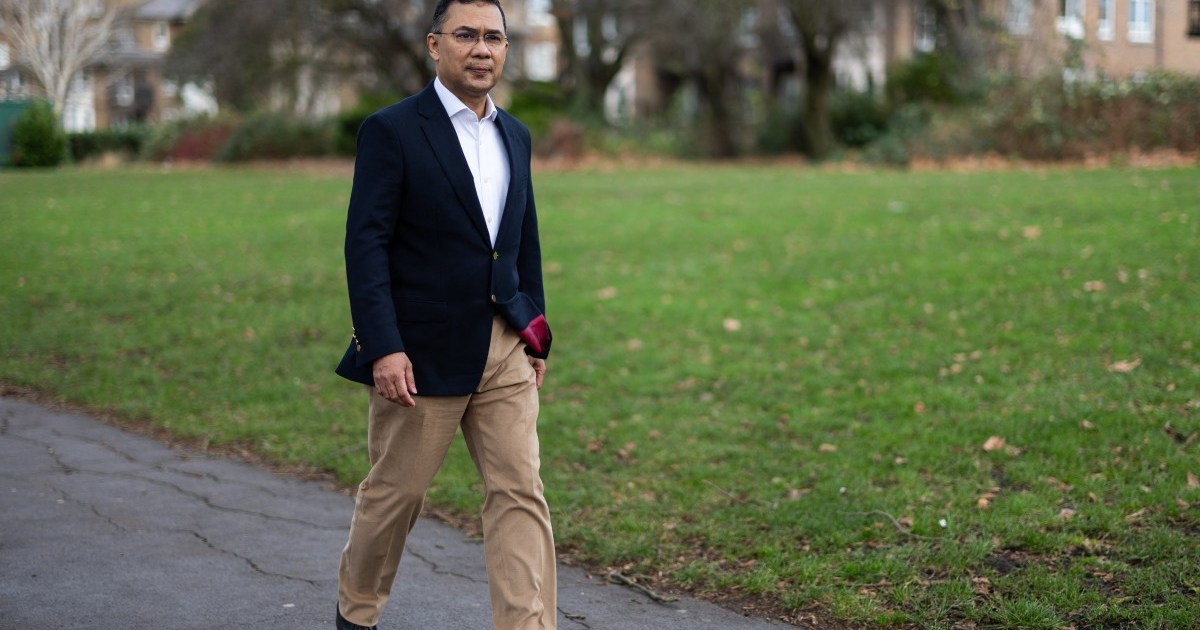

On Christmas Day this year, Tariq Rahman – the Bangladesh Nationalist Party’s (BNP) heir apparent and believed by many to be the country’s next prime minister – returned home and stepped directly into the ever-increasing power vacuum following the fall of the Awami League government in August 2024.
After 17 years in exile, Rahman’s act of touching the soil is carefully staged for the cameras, but the effects are structural rather than symbolic. Bangladesh today is a state without a stable pulse, and its return ends the country’s brief post-revolutionary hiatus.
Five days later, on December 30, the political moment hardened into historical finality. Khaleda Zia – former prime minister and wife of BNP founder and former Bangladesh president Ziaur Rahman – died after a long illness, breaking the last living link of the party’s original leadership generation.
Rehman is no longer Khaleda Zia’s successor. He is now the leader of the BNP as it heads to the polls on February 12.
The nation Rahman left in 2008 was fractured; It is structurally compromised where it now resides. The uprising against Sheikh Hasina hastily ended a decade and a half of autocratic rule in India, but left a hollowed-out bureaucracy and a broken social contract.
As the interim administration of Muhammad Yunus tries to manage the transition, street power has already begun to overtake formal authority. Amidst this instability, Rahman’s presence acts as a high-voltage conductor for the BNP, providing a focal point for opposition that has until recently been systematically suppressed.
For millions who saw last decade’s elections under Hasina’s authoritarian grip as a foregone conclusion, Rahman represents a return to favor.
Yet Rahman is no rebellious outsider; He is the end product of the system he wants to lead. As the son of two of the country’s former leaders, he has a dynastic legacy closely tied to the patronage networks that have long hampered Bangladeshi governance. His earlier proximity to power was marked by allegations of informal authority and corruption – allegations that continue to serve as political ammunition for his opponents. To supporters, he is a victim of judicial excesses; For critics, it is proof of why Bangladesh’s democratic experiment is collapsing under the weight of elite punishment.
This duality defines his return tension. Rahman is now trading the rhetoric of a street movement for the measure of a politician. His recent speeches – emphasizing minority protection, national integration and the rule of law – make a leader acutely aware that the youth who helped oust Hasina will not accept even a simple change in the identity of the ruling elite.
The BNP that he now leads, Bangladesh faces a more integrated and less tolerant of opaque politics globally. If Rahman takes over, the judiciary and Election Commission will be under pressure to reform immediately. Without institutional credibility, any mandate it secures will have a dangerously short shelf life.
Financially, Rahman is likely to maintain practical consistency. Bangladesh’s dependence on garment exports and foreign investment leaves little room for ideological experimentation. The real test will be internal discipline. The temptation to settle old scores and reward loyalists through the same rent-seeking channels used by previous regimes will be great. History suggests that this is where Bangladeshi leaders fail – and the country’s current economic fragility makes no difference to such indulgence.
However, the most delicate area will be foreign policy – specifically, relations with India. Over the years New Delhi has found an approximate, if transactional, partner in Sheikh Hasina. The BNP, by contrast, has long been viewed with suspicion and strategic uneasiness by Indian security circles.
Rahman now appears to be signaling a move away from nationalist opposition to what he describes as “balanced sovereignty”. He understands that Bangladesh must restore its ties with India to satisfy domestic sentiments, but it cannot tolerate antagonism towards its most influential neighbour. For India, the challenge is to accept that a stable, pluralistic Bangladesh – even under a familiar rival – is preferable to a perpetually unstable Bangladesh.
Ultimately, Rahman’s return is a stress test not just for Bangladesh, but for the idea of democratic choice in South Asia. This is not a simple dynastic succession; It is a reckoning. After years of enforced stability and managed outcomes, the recurrence of political uncertainty is, paradoxically, a sign of democratic life.
Whether Tariq Rahman uses this opening to rebuild the institutions he once left behind — or return to habits of the past — will determine more than his personal legacy. Whether Bangladesh can finally break its cycle of exile and revenge will determine whether it is just preparing for the next collapse.
The views expressed in this article are the author’s own and do not reflect the editorial position of Al Jazeera.