

One of the most talked about and covered halftime performances Super Bowl the story took place this Sunday, February 8.
“How rich it is to be Latino” Bad Bunny he declared at the start of the show at Levi’s Stadium in Santa Clara, California. What followed were 13 minutes full of symbolism, history, folklore, and flavor—messages steeped in politics and intent.
In the 2020 Super Bowl, also during donald trumppresidency of – Shakira i Jennifer Lopez made a similar cultural statement by highlighting Latino traditions: Puerto Rican flags, champeta, casino salsa and the unforgettable “Hola Miami.” But Benito Antonio Martínez Ocasio took the message even further. He was not content with just language and musical traditions; he fine-tuned the details, introducing images that required deeper explanation, such as sugarcane fields and exploding lightning bolts.
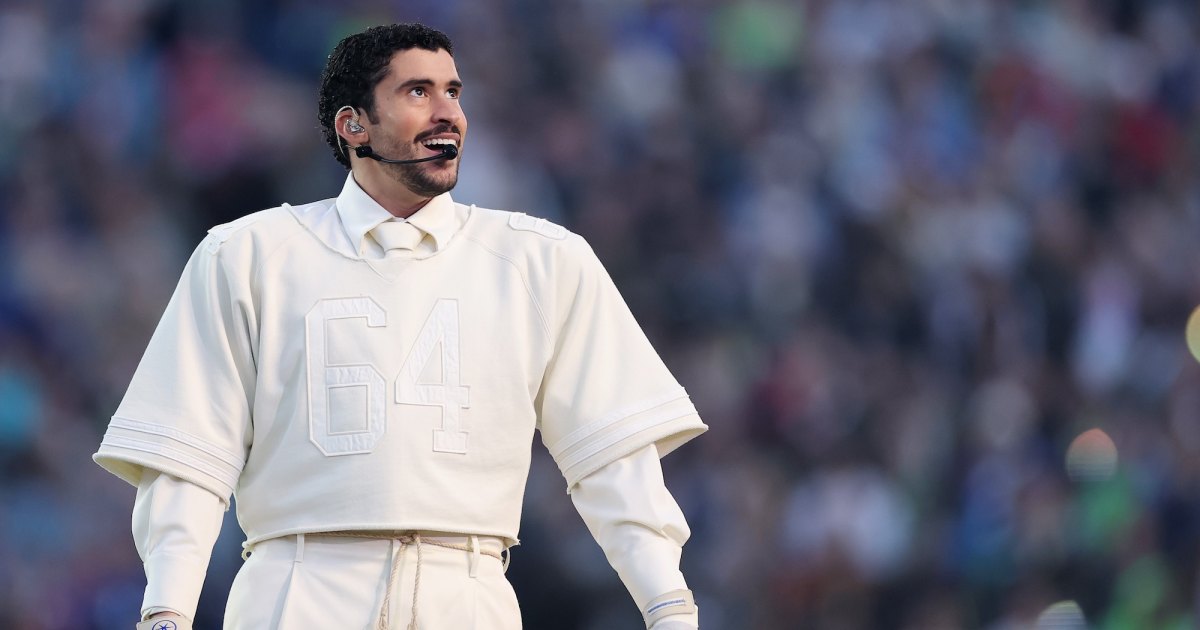
Bad Bunny appeared dressed in pure white, with his natural hair free of jewelry or extravagance, but with a freshly polished Grammy for Album of the Year. Contrary to online speculation, he did not present her with the award Liam Ramosthe child detained by ICE in Minnesota, but a Lincoln Foxa young actor who plays Bad Bunny as a child.
“I will remember this day forever. It was a true honor,” Fox later wrote on Instagram.
When they played the opening notes of “Nuevayol”, the audience’s reaction was immediate. Bad Bunny is not just a Puerto Rican artist, he represents the entire continent. On that stage, he represented all the Latinos and all the nationalities that make up the American continent, closing a show full of creativity, talent and symbolism.
Read on to understand some of the show’s most iconic moments:

Bad Bunny had family on his mind when he took the field for the 2026 Super Bowl halftime show. The rapper, whose real name is Benito Antonio Martínez Ocasio, wore a custom cream T-shirt for his performance, with “Ocasio” on the back and the number 64. “Bad Bunny paid tribute to his uncle who played football (…)
The whole is always significant and changing
The performance opened with a cinematic sequence in the sugar cane fields, a powerful symbol of Puerto Rico’s history, filmed as what appeared to be a single, unedited shot. For decades, the sugar industry shaped the island’s economy and social fabric, and by entering this landscape, Bad Bunny paid tribute to generations of workers whose work sustained the country.
As the show progressed, the stage filled with everyday scenes of Latino communities: a nail salon, young women working on a construction site, and Villa’s Tacos, a beloved Los Angeles taqueria founded by an immigrant from Michoacán (marking the first clear nod to the Mexican-American community). There was also a pawn shop and a pirogue cart, a traditional Puerto Rican shaved ice place, reminiscent of old San Juan. The syrup bottles displayed flags of Puerto Rico, Colombia, Mexico and Spain, a visual salute to Latino diversity.
boxers Xander ZayasPuerto Rican and Emiliano VargasMexican-American, they were shown training: vivid pictures that reinforce a clear message: The Latino working class has helped shape the history of the United States. Nostalgia arrived with grandparents playing dominoes, a deeply Caribbean image.
La Casita takes the stage, full of stars
One of the central elements of the show was La Casita, a recurring symbol in Bad Bunny’s tour and residency in Puerto Rico. Inspired by the traditional houses and garage parties of the 80s and 90s, widely considered the birthplace of reggaeton, La Casita represented the origins of perreo and community celebration.
Celebrities included cardi b, Karol G, Peter Pascal, Jessica Alba, Alix Earle, Ronald Acuna Jr., Young Miko i Dave Grutman they appeared dancing together as a community. The screens displayed words like “perreo,” while the iconic sapo concho, a symbol of Puerto Rico that Bad Bunny has adopted as the tour’s “mascot,” made an appearance. The endemic species has since become what many now call the “Latin Labubu”.
Lady Gaga… Salsa style
From La Casita, Benito traveled to a mechanic before returning to the fields to pay tribute to the reggaeton pioneers with classics like “Pa’ Que Retozen,” “Dale Don Dale” and “Gasolina,” complete with fiery choreography and the first halftime appearance of a same-sex couple dancing side-by-side.
As El Conejo Malo greeted the crowd with “Buenas tardes, California,” the violins ushered in a romantic tune performed by Cindy Shea’s Mariachi Divas, an all-female mariachi group from Los Angeles. That moment led to one of Bad Bunny’s most powerful statements: “My name is Benito Antonio Martínez Ocasio, and if I’m in Super Bowl LX today, it’s because I never — never — stopped believing in myself. You should believe in yourself, too. You’re worth more than you think. Believe me.”
That speech set the stage for a surprise: an actual wedding performed live during the halftime show.
The main stage was transformed into Puerto Rico, revealing one of the biggest surprises of the night: Lady Gaga performing a salsa version of “Die With a Smile” alongside Puerto Rico’s Los Sobrinos.
The complex had a guard tower and lanterns from Old Saint John. Gaga wore light blue, the original shade of Puerto Rico’s flag, historically altered after it was banned from 1898 to 1957. Bad Bunny reinforced the message by displaying the flag in that same blue without saying a word. Gaga also wore the fleur de maga, the national flower of Puerto Rico.
From there, Bad Bunny launched into the beat of “Baile Inolvidable,” turning the wedding into a classic Latin rumba that extended well into the night. How do we know? He approached the now famous “three chairs”, woke a small boy sleeping with a football as a pillow and invited him to join the celebration.
Later, in a literal leap of faith, Bad Bunny jumped from the upper level as “Nuevayol” played, transitioning to scenes of the diaspora dancing in the streets. A traditional cellar appeared outside Toñitaa legendary figure in New York’s Puerto Rican community and owner of the Caribbean Social Club.
Who was the 5-year-old who received the Grammy?
One of the most symbolic scenes showed Bad Bunny presenting his Grammy to a child who was watching his speech on television with his parents. Many interpreted it as a reference to Liam “Conejo” Ramos, the boy detained by ICE in Minneapolis weeks earlier. The boy was later confirmed to be child actor Lincoln Fox.
The moment could also have symbolized Bad Bunny handing the award to his younger self, reassuring “Benito el nen” with a pat on the head: everything will be alright if you believe in yourself.

After joking that English speakers had “four months” to learn Spanish for his Super Bowl 60 halftime show during his Saturday Night Live hosting gig, Bad Bunny insisted the performance will be an all-inclusive party. “They don’t even have to learn Spanish,” the 31-year-old rapper said Thursday, February 5, during the Apple Music Super Bowl (…)
A tribute to Ricky Martin
Another powerful moment highlighted Ricky Martinsitting in a set that recreates the cover of I should have taken more pictureswith white chairs and iconic bananas. “They want to take the river and the beach too,” he sang, performing “Lo Que le Pasó a Háwái,” a Bad Bunny song that addressed cultural displacement.
‘God bless America!’
The show’s political tone was made explicit during “Un Aapagón,” performed atop a set of electric poles, a clear reference to the ongoing energy crisis in Puerto Rico since Hurricane Maria in 2017. Without safety gear, Bad Bunny climbed the poles, delivering a scathing critique of neglect and mismanagement.
In the end, Bad Bunny appeared alongside Los Pleneros de la Cresta. As the music played, he said, “God bless America” before naming every country in the Americas from Chile and Argentina to Canada, reminding viewers that America is much more than just the United States. He closed with: “Mi patria, Puerto Rico.”
The final message on the screen read, “The only thing more powerful than hate is love,” as Bad Bunny threw a ball to the ground in a classic touchdown celebration. The ball read, “Together we are America.”
With reports from Norma Gómez and Julia Tortoriello