

What happened?
last month, Maccabi Tel Aviv fans have been banned from attending Thursday’s Europa League game against Aston Villa at Villa Park over security concerns, prompting criticism from politicians including Prime Minister Sir Keir Starmer.
The Israeli club later stated in a statement that will not sell tickets to their fans for the match.
More than 700 police officers will be on duty with police horses, police dogs and a drone as part of the operation, and protests by various groups will take place on the day.
The decision to ban supporters was based on West Midlands Police’s concerns about its ability to deal with potential protests over the Israel-Gaza war.
West Midlands Police said the match was classified as “high risk” after carrying out a “thorough” assessment “based on current intelligence and previous incidents, including violent clashes and hate crimes that occurred during the 2024 Europa League match between Ajax and Maccabi Tel Aviv in Amsterdam”.
The UK government said it was doing “everything in its power” to overturn the ban and ensure fans can safely attend the game.
On October 19, the Tel Aviv derby between Maccabi and Hapoel Tel Aviv was called off after what police described as “public disorder and violent disorder” in which 12 people and three police officers were injured.
The following day, Maccabi Tel Aviv released a statement saying they would not be selling tickets to fans for the Europa League game at Villa Park.
In a statement from a spokesman for the British government in response to Maccabi’s decision to deny the sale of tickets to fans, it is stated that they are “deeply saddened” by the decision.
Why did Maccabi Tel Aviv refuse to sell tickets to fans?
In a statement, Maccabi said: “The welfare and safety of our fans is paramount and, based on hard lessons learned, we have taken the decision to reject any award offered on behalf of away fans, and our decision should be seen in that context.”
“We hope that circumstances will change and we look forward to being able to play in Birmingham in a sporting environment in the near future.”
The statement questions the motives of those who want to justify the ban.
“We acknowledge the efforts of the British Government and the police to ensure that both sets of supporters can safely attend the game and are grateful for the messages of support from across the football community and society as a whole,” the club said.
“Our first team is made up of Muslim, Christian and Jewish players and our fan base also cuts across ethnic and religious divides. We also work tirelessly to tackle racism within the more extreme elements of our fan base.
“It is clear that various entrenched groups seek to disparage the Maccabi Tel Aviv fan base, most of whom have no truck with racism or hooliganism of any kind, and exploit isolated incidents for their own social and political ends.”
“As a result of the hate-filled untruths, a toxic atmosphere has been created that jeopardizes the safety of our fans who wish to attend.”
Why will there be 700 police officers at Villa Park?
Police have issued disruption warnings as more than 700 officers prepare to protect the public and deal with any crime and disorder.
Those not attending the game have been warned to avoid the area as police expect “significant disruption”.
Birmingham Police Chief Superintendent Tom Joyce said: “We know there will be protests by different groups on the day and we have plans in place which balance the right to protest with our duty to protect all communities in Birmingham.
“Our aim in the planning for this game is to ensure that people can enjoy a football game while we continue to keep everyone in Birmingham safe.”
Who decided to ban Maccabi Tel Aviv fans?
A statement from Aston Villa said the decision “follows instructions” from the Birmingham Security Advisory Group (SAG), based on advice from West Midlands Police.
Safety Advisory Groups are responsible for issuing safety certificates for matches.
However, according to the government’s health and safety executive website, safety advisory groups are “non-statutory bodies and therefore have no statutory powers or responsibilities, and are not empowered to approve or prohibit events”.
The website adds: “Event organizers and others involved in the running of the event retain primary legal obligations to ensure public safety.”
The UK Football Policing Unit (UKFPU) was also involved in providing advice on the decision.
“The UKFPU supported West Midlands Police in gaining access to full details of previous incidents in Amsterdam via the European Police Network so that all relevant information was available to them,” the statement said.
“Following this, the UKFPU last week informed the Home Office of the potential issues and options that the Security Advisory Group (SAG) could take, including restrictions on away fans.”
Who are the Security Advisory Group?
The Birmingham Safety Advisory Group (SAG) is chaired by Birmingham City Council’s Head of Resilience and is made up of representatives from the local authority, emergency services and event organisers.
The government’s Health and Safety Executive website says the purpose of SAG is to “provide a forum for discussion and advice on public safety at an event”.
It added: “SAG should notify the event organizer of any public safety issues that they feel require further consideration, explaining their reasons. It is the responsibility of the event organizer to take all appropriate action.”
Safety Advisory Groups are held for events that pose a “significant risk to public safety, in terms of the number and profile of people attending, or the nature of the event’s activities and/or environmental challenges.”
What happened at the match between Ajax and Maccabi Tel Aviv?
The Europa League match between Ajax and Maccabi Tel Aviv, according to West Midlands Police, took place on 7 November 2024.
Violent clashes between pro-Palestinian protesters and Maccabi Tel Aviv fans broke out before the game, leading to more than 60 arrests, four men given short prison sentences and another given community service.
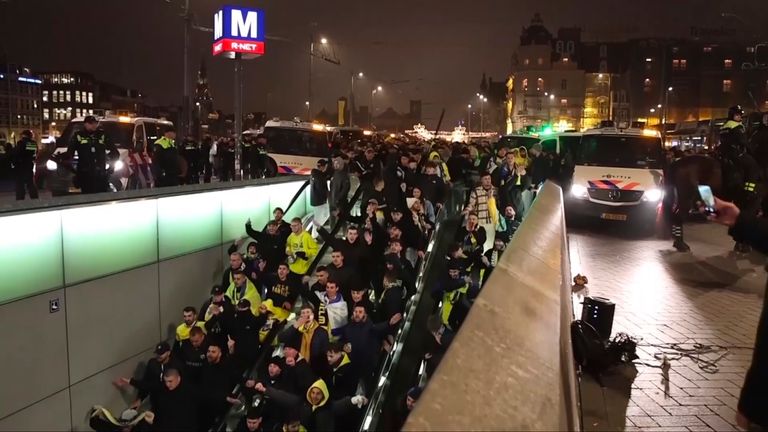
Maccabi Tel Aviv supporters are escorted by police to the metro after pro-Palestinian supporters marched near the Johan Cruyff stadium
Five people were taken to hospital after riots broke out in several areas of the Dutch capital.
Amsterdam police and prosecutors said the “anti-Semitic” rioters “actively solicited” Israeli supporters to assault and attack them. Footage has surfaced online showing fans tearing down the Palestinian flag in central Amsterdam and chanting anti-Arab chants.
A report from the Amsterdam mayor’s office said the violence stemmed from a “toxic combination of anti-Semitism, hooliganism and anger” over the war between Israel and Gaza and other conflicts in the Middle East.
Maccabi Tel Aviv’s next European away game against Besiktas on November 28 was moved to Debrecen, Hungary by UEFA after the Turkish authorities decided not to host it in Turkey. The Hungarian authorities decided to play the game behind closed doors.
What was the key reaction to the supporter ban?
West Midlands Police he said he “supports the decision to ban supporters from attending”.
West Midlands Police and Crime Commissioner Simon Foster later called Birmingham City Council’s Safety Advisory Group and West Midlands Police to immediately review the decision to ban Maccabi fans from Tel Aviv.
Prime Minister Keir Starmer criticized the decision and said that “the role of the police is to ensure that all football fans can enjoy the game, without fear of violence or intimidation”.
Leader of the opposition Kemi Badenoch he described the decision as a “national disgrace”.
Aston Villa they said they were “in continuous dialogue” with Maccabi Tel Aviv and the local authorities.
Jewish Leadership Councilwho works to protect British Jews, said it was “perverse for away fans to be banned from a football match because West Midlands Police cannot guarantee their safety”.
Ayub Khan, Independent MP for Birmingham Perry Barrwelcomed the news that Maccabi Tel Aviv fans would not be allowed to attend the game.
Is there any precedent for the ban?
The decision to ban fans from attending a UEFA match for security reasons is rare, but it has happened before.
Last season, French authorities ordered PSV Eindhoven not to take supporters to a Champions League game against Paris Saint-Germain.
PSV announced that there is a “total travel ban” for their supporters “to and within Paris” and added that the decision “came completely unexpected”.
French police have cited previous unrest with supporters, including an incident against RC Lens in 2023, PSV said in a statement.
Last season, Legia Warsaw fans are prohibited from entering Villa Park for their UEFA Conference League match after four police officers were injured during clashes with fans of the Polish club.
The match was postponed and Villa said that the decision to stop Legia fans from entering the field was made for security reasons.
Could Israeli clubs be banned from European competitions?
UEFA and FIFA faced calls to suspend Israeli national teams and clubs from international competitions ahead of this week’s ban over the Gaza conflict.
Spanish Prime Minister Pedro Sanchez is among those who have called for the Israeli teams to be banned. A UN advisory group of experts also said sports sanctions were needed after a UN commission of inquiry said Israel was committing genocide in Gaza.
According to Ski Newsdiscussions have taken place at the highest levels in European football, but no decision has been made.