


Frank GardnerBBC Security Correspondent

 PA Media
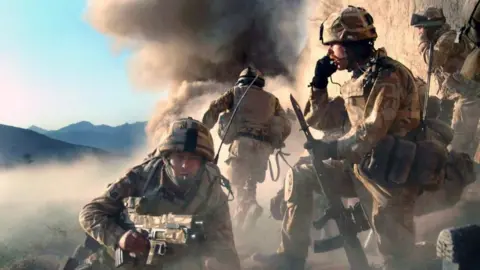
Blast walls, rocket attacks, Forward Operating Bases (FOBs), Improvised Explosive Devices (IEDs)…and long queues at the canteen. Anyone who deployed to Afghanistan, in any capacity, between 2001-2021 will have their own vivid memories of that time.
It starts flying in – in Kandahar, Kabul or Camp Bastion. It could be a long, slow descent with the lights off in an RAF jet, or a fast corkscrew in a C-130 transport plane. In both cases the goal was to avoid being blown up by a Taliban surface-to-air missile.
For 20 years thousands of servicemen and women, as well as civilians, from many countries have been sent to Afghanistan, responding to the US call for help.
That call came in the form of Nato invoking Article 5 of its charter – the only time this has happened in Nato’s 77-year history – which states that an attack on one member will be considered an attack on all.
America is reeling from the devastating 9/11 attacks when al-Qaeda, backed by the Taliban in Afghanistan, killed nearly 3,000 people by flying packed airliners into New York’s Twin Towers and the Pentagon in Washington.
The Taliban were quickly driven from power by the combined efforts of the US military, the CIA and the Northern Alliance in Afghanistan.
Then it was all about trying to find the remnants of al-Qaeda as Britain’s Royal Marines, along with UK Special Forces, chased them over the mountains but many escaped to safety to regroup in Pakistan.
Ten years later Seal Team Six commandos of the US Navy tracked down the leader of al-Qaeda, Osama Bin Laden, in a villa in Abbottabad, Pakistan.
The first two years of the US-led “Operation Enduring Freedom” as it was called, were relatively quiet. In late 2003, as America’s attention shifted to Iraq, the US soldiers we met even began to refer to Afghanistan as “Op Forgotten”. But it’s still dangerous.
From the rain-soaked Kandahar airbase we watched Romanian troops nervously patrol in their Soviet-era armored vehicles, on the lookout for the next ambush.
Flying over a remote US-manned firebase in the mountainous Paktika province in a Blackhawk helicopter, my BBC crew and I were happily told: “You’ve arrived at the worst place in the world”.
Sure enough, the Taliban launched Chinese-made rockets at the base after dark, planted there, we were told, by farmers hired or forced to do so.
Everything changed after 2006, when the UK deployed forces in Helmand province, a part of Afghanistan that had been relatively peaceful until then.
The Taliban made their intentions clear. If you come, they said, then we will fight you.
And yet the UK government at the time appeared to be shocked by the ferocity of the fighting 3 For now found themselves involved, with British paratroopers calling in mortar and artillery fire so close to their positions that it was called “dangerously close”, in an effort to stop their bases from being overrun.
Over the next eight years, until the end of combat operations in 2014, Americans were not the only ones risking life and limb to serve in Afghanistan.
Brits, Canadians, Danes and Estonians are among those who have seen the hardest fighting in Kandahar and Helmand provinces. It is also fair to ignore the courage and sacrifice of many Afghans who have fought and died in two decades.
I say “combat” but many of the soldiers’ greatest fears come from hidden IEDs, expertly hidden Improvised Explosive Devices. The Taliban, who of course know every inch of their terrain, can always guess exactly where the troops need to cross an irrigation ditch or canal and therefore place the bomb accordingly.
Within a second, in a blinding flash and a puff of black smoke, a healthy, healthy, 20-something individual ends their life or changes in disaster, facing amputation and many other complications.
These IEDs are so outnumbered that soldiers walk out the gates of their FOBs – Forward Operating Bases – on patrol praying that if they get hit it will result in a below-the-knee amputation, not one above the knee.
The courage and resilience of the people I have ever met, who have managed, despite terrible loss and hardship, to turn their broken lives around, is both humbling and awe-inspiring.
These are just some of the people who responded to America’s call for help after the 9/11 attacks.
It is not surprising that there is such national anger at the proposal of the President of the country that they somehow avoided the fight.