
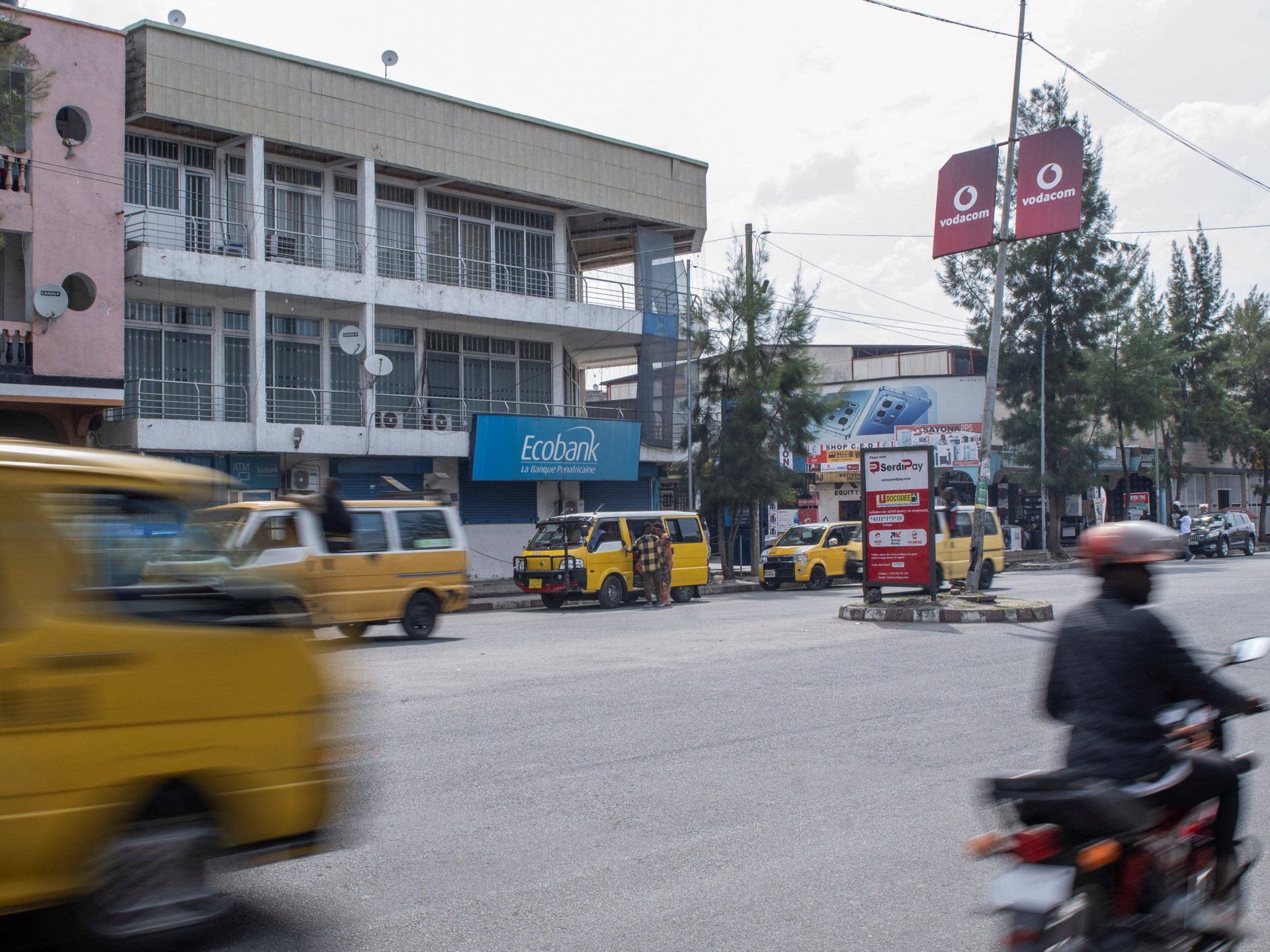

Goma, Democratic Republic of the Congo – A year after M23 rebels took control of Goma, the capital of the DRC’s strategic North Kivu province in the east, foot and car traffic on the streets and markets are operating almost as normal.
But across city streets, some much-needed buildings remain closed.
Recommended stories
3 List of itemsEnd of list
On one street, the yellow and black logo of Roebank stands above a bolted door and a closed ATM machine; Nearby, a blue and white Ecobank sign stands above a door closed by a large blue shutter; And on another street, there are blue and orange Access Bank logos and flags plus locked doors.
It was early Monday, January 27, 2025While M23 rebels made good on their threat a few days earlier and captured Goma, before advancing into the east of the DRC and seizing other major cities in the weeks and months that followed.
Due to the deteriorating security situation, all banks in Goma were closed and ATMs stopped working. The effects on the local population were drastic – and immediate.
Sitting in the doorway of the pharmacy she runs in central Goma, Shaila Zawadi watches the traffic on the street and explains how her business and livelihood have changed over the past year.
She has an account at Access Bank, but lost her bank card before the city fell to the rebels – and doesn’t have a mobile banking app to transact electronically.
Fortunately, she has a Visa card, which allows her to withdraw money – as long as she can find a bank or ATM.
So, like many others in Goma, the 37-year-old mother of three decided to make a plan – move from Goma to neighboring Rwanda and find a bank.

“I had to cross the border to get to an ATM in Rwanda,” says Zawadi.
But the workaround came with challenges — and more costs.
“To withdraw the equivalent of $100, I had to pay an ATM fee of up to $15. And in Rwanda, I could only withdraw in the local currency, which was the Rwandan franc.”
After that, she would cross from Rwanda, meeting informal money traders at the border in Gisenyi and Goma, who would help convert Rwandan francs into dollars and then into Congolese francs. But she loses money with every exchange.
“It’s more expensive to withdraw money in another country. If only the banks were open again,” she complains.
A year has passed since the closure of the banks, even though the security situation has normalized, they have not resumed operations. The government in Kinshasa and the M23 authorities who now run the city’s trade have been quick to point the finger at who is responsible, while the banks themselves have not said much or referred to the “temporary closure” due to the “security situation”.
The border between Gisenyi and Goma is always busy. People line up in single file to cross from one side to the other. Every day, dozens rush to ATMs and banks in downtown Gisenyi to withdraw their money. Others also use ATMs installed in customs offices between the DRC and Rwanda.
Meanwhile, in Goma, the economy is cash-based, or for those who can, electronic transfers.
In the city’s main market, traders and shoppers say prices of goods have gone up, while everyone is struggling to make ends meet.
“Earlier, we used to buy in bulk at affordable prices. Today, prices have risen sharply and consumers are no longer buying anything,” said trader Esperance Musashin. “We are holding on as best we can, but the situation is not improving.”

Difficult to ‘get the economy back on track’
Before M23 rebels took over Goma a year ago, there were days of fighting.
The Rwandan-backed group is one of 100 armed groups operating in the east. It claims to be fighting the government for the rights of the DRC’s minority Tutsi population.
Days before M23 took Goma, the military governor of North Kivu, Congolese General Peter Sirimwami, was killed on the front line in a rebel attack.
A day later, the rebels announced they would capture Goma and warned the Congolese army, say its allied militia. patriotSouthern African Development Community (SADC) troops, Burundian troops, European mercenaries and peacekeepers will surrender.
On Sunday night before the blockade, at 10 pm local time (20:00 GMT) the rebels entered the city in military uniform amid heavy gunfire and explosions.
Early Monday, they announced they were in control of Goma, while Congolese soldiers and their allies fled or surrendered.
The Congolese government later said thousands of people had been killed in the M23 advance, while hundreds of thousands had been displaced.
After that, the rebels, who said they had brought peace to the city, soon advanced to other parts of eastern DRC, capturing Bukavu, the capital of neighboring South Kivu province, and other major towns and cities in the coming months.
In Goma, the leadership change brought relief to many citizens, but for others, the challenges were just beginning.

Banking transactions, withdrawals and transfers have become a marathon – and many say they feel abandoned to their unfortunate fate.
Gustave Katsuwa, a resident of Goma, owns his assets through Kenyan Bank Equity BCDC, one of the main banks operating in eastern DRC. Despite the closure of banks in Goma, he says he is managing his account as if nothing has changed.
“Those of us who are lucky enough to request or access online banking can access our money and our salaries through mobile apps and we have many options for cash withdrawals. I can see notifications related to my salary payments,” he said, adding that he can transfer money from his bank account to Mobile Money.
But he says he loses about 3 percent of his money every time he withdraws dollars in the city of Goma.
Financial analysts say the closure of commercial banks is weakening the local economy and creating a dollar shortage in an economy that has been dollarized for decades.
“Closing banks and microfinance institutions does not facilitate capital and currency circulation,” said Dev Bengeya, a professor at the University of Goma. “It doesn’t make it any easier for the economy to get back to normal.”
According to a financial analyst who spoke to Al Jazeera on condition of anonymity, “Banks were closed after authorities in Kinshasa lost control of Goma. Billions of dollars of savers’ money in banks in rebel-held territory cannot be left to chance.” The authorities in Kinshasa were and are “solely responsible” if money was lost because of the war, and they avoided the worst by closing the banks and moving the cash to “safer” places, away from “the sound of boots”.
Since the fall of Goma, M23 rebel leaders and Congolese officials have been accused of closing banks in Goma and other regions under M23 administration.
The coordinator of the M23-AFC political-military coalition believes that withholding the savings of the population against their will could amount to a war crime.
“They have ordered banks not to open. Banks are keeping savings as ordered by (President Felix) Tshisekedi,” said M23-AFC head Cornel Nanga Yobeluo.
The allegations are false, according to Congolese officials, who describe them as “misleading”.
“Banks are not closed by government order. No bank can legally operate under US sanctions,” Congolese Communications Minister Patrick Muaya Katembwe stressed during a media briefing last year.
Al Jazeera contacted the banks to ask about the reasons for the continued closures, but most did not respond. Access Bank in eastern DRC said it was “not authorized” to comment. Equity BCDC Bank did not respond, but in a rare statement published in July last year, it informed customers that “branches in Goma and Bukavu have been temporarily closed for several months due to the security situation.”
The ‘elusive’ silence
Although economically, there is much to complain about after the closure of the banks and Goma International Airport, the population is divided over the takeover of Goma.
M23 leaders say they have brought peace and basic services to the city, including a steady supply of water and electricity – and many residents agree.
“Since AFC came here, we have seen an improvement in the overall security of the population because today, at least, we can sleep in peace. There are no more targeted killings by motorcyclists and money changers. Peace reigns in Goma,” says Gentil Mulume, a resident.
According to M23, there were about 50,000 armed men before the city of Goma was captured, and they say this over-militarization is the root cause of instability in North Kivu.
Mulume also said that the AFC-M23 officials have good faith in solving the social problems of the people of Goma.
“The city now has round-the-clock water, no more water shortages and no untimely power cuts. We are seeing work on road infrastructure.”

Still, other residents disagree.
“Did they bring electricity to Goma? Did they bring water? Did they find Goma without roads?” asked Dieudon Muweza, an architect who believes M23-AFC leaders must prove themselves.
“I think the M23 leaders should show us the difference between their way of governing and that of Kinshasa,” he observed, adding that nothing has changed. He hopes for the complete withdrawal of the M23-AFC from all areas under their control.
Muweza has been on the job since M23 took over the city and wants all ongoing peace initiatives to end so that the Congolese can experience the “endless peace” that currently seems “elusive”.
A year since the M23’s rapid progress, peace deals brokered by the United States and Qatar have been signed by the rebels and the DRC’s government, while regional efforts are also underway. Rebels recently withdrew from the town of Uvira, on the border between the DRC and Burundi, allowing the “symbolic” return of Kinshasa-installed authorities.
But for the Congolese in the east of the country, the future is uncertain.
“They (M23) have done a good job with security, but we are very hungry,” said David Linda, a resident of Goma. “The peace is good. The people are sleeping well. The guns are quiet. But we have no food.”
A year after her life and bank account were thrown into disarray, pharmacy owner Zawadi – like other professionals in Goma – is still looking for ways to make ends meet. Most of her customers pay her using internet or mobile banking, electronically deposited into her bank account. Even then, she crosses the border into Rwanda to withdraw foreign currency and convert it into US dollars and then back into Congolese francs – losing a percentage on each transaction.
She finds this expense difficult to bear, especially in times of conflict and uncertainty, where every expense has to be carefully weighed. But until the banks reopen, this is her only option.