
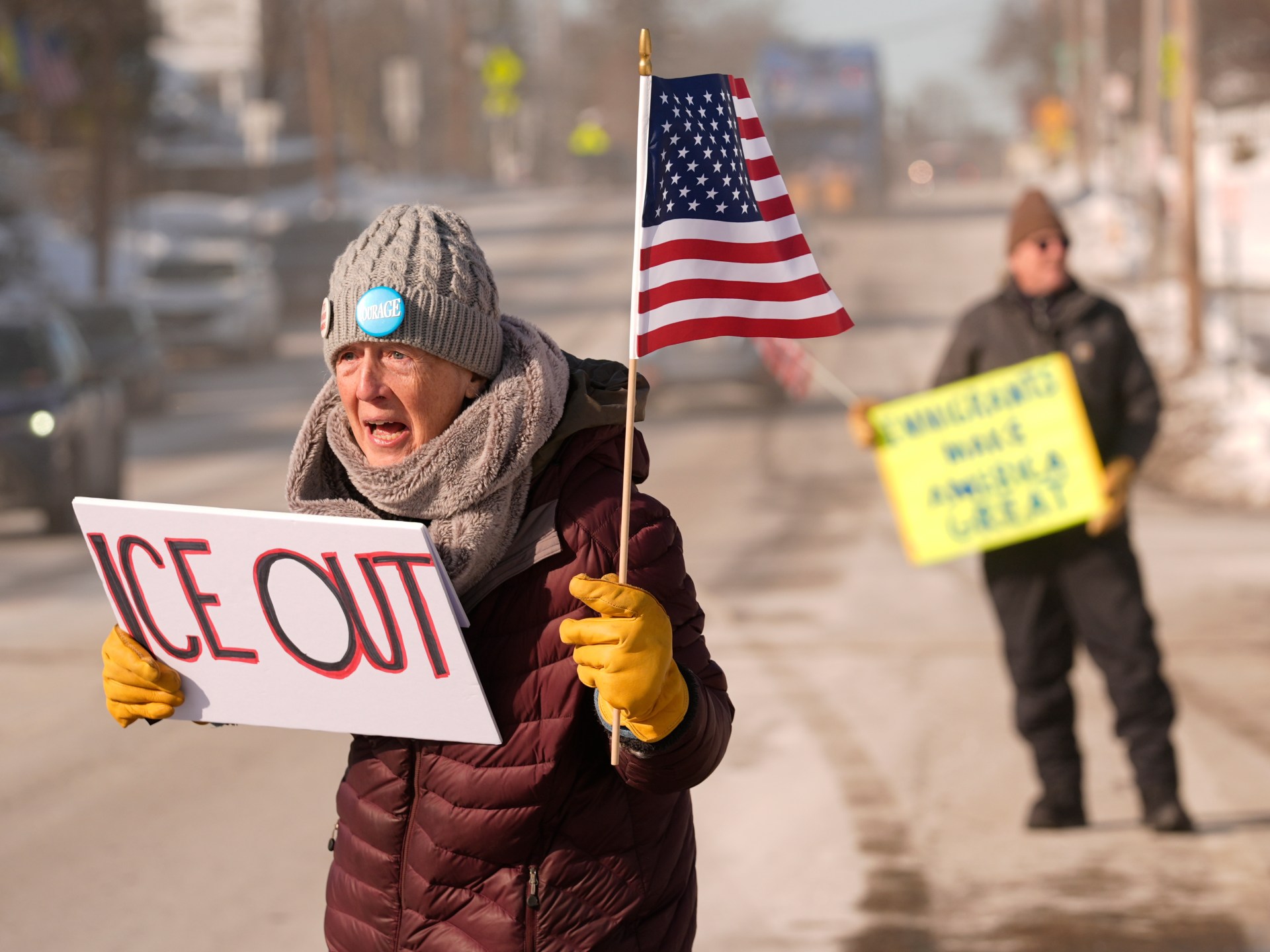

The administration of United States President Donald Trump has announced an immigration enforcement operation in the northeastern state of Maine this time.
On Wednesday, the Department of Homeland Security confirmed that the immigration raids, dubbed “Operation Catch of the Day,” had begun a day earlier.
Recommended stories
3 List of itemsEnd of list
In a statementA Trump administration spokeswoman indicated that targeting Maine was a political response to the ongoing feud between the president and the state’s governor, Democrat Janet Mills.
“Governor Mills and her fellow sanctuary politicians in Maine have made it abundantly clear that they will stand by criminal illegal aliens rather than protect law-abiding American citizens,” spokeswoman Tricia McLaughlin said.
But rumors abound that Maine has been singled out for its significant Somali American population in the cities of Portland and Lewiston. Estimates put the total number of Somali Americans in the state at about 3,000.
Trump has repeatedly criticized the Somali community over the past several months, comparing its members to “garbage” during a December cabinet meeting. As recently as Tuesday, he used the White House podium to call Somalis and Somali-Americans “people of very low IQ.”
Racist and anti-immigrant rhetoric has been a trademark of Trump’s campaign for public office, and he has repeatedly accused certain groups — including Haitians and Mexicans — of falsely tying their immigrant identity to widespread criminal activity.

Parallel with Minnesota
Trump has focused on the Somali community after a handful of members were caught in a fraud scandal in Minnesota, the Midwestern state where an immigration enforcement operation was launched in December.
Those efforts have been marked by violent clashes between federal agents and protesters, and one woman, 37-year-old Renee Nicole Good, was shot and killed in her car after an interaction with Immigration and Customs Enforcement (ICE).
Fears that those tensions could spill over into Maine dominated Wednesday’s news conference with city officials in Portland.
Mayor Mark Dion told reporters that the region’s immigrant community felt “anxious and fearful” as ICE agents began their crackdown.
“They see this action as unpredictable and a threat to their family,” he explained.
He also questioned whether a heavy-handed operation was necessary to deal with immigration violations in the area, and he called on ICE to adopt a different tactic than in Minnesota.
“I want to underscore an important point: While we respect the law, we challenge the need for a paramilitary approach to enforcing federal laws,” Dion said.
“Federal immigration law is legal. Its administration and enforcement is legal,” he added. “What we are concerned with, as a council, is the enforcement strategy that ICE has undertaken in other communities, which in our minds appears to intimidate and intimidate the population.”
Nevertheless, Dion expressed optimism that ICE will adopt a more accommodating approach to apprehending local suspects.
The city of Minneapolis, Minnesota, has seen nearly 2,000 immigration officers fill its streets, while the mayor predicted that Maine will not see “a bunch of federal agents.”
“We’re seeing very individualized activity by ICE. An individual here, a neighborhood there,” he said. “Their conduct, at least as it stands right now in Maine, seems focused, which would indicate to me — and this is speculation — that they’re acting based on actual court warrants.”
It marked a move away from the “random, I-don’t-have-your-papers type of experience” that Minnesota residents have experienced, he said.

Outrage over ICE operations
Still, Dion advocated a wait-and-see approach to ICE operations, while other city officials took a hard line.
A Portland city councillor, Wesley Pelletier, described the unfolding raids as part of a “white nationalist agenda and justification”.
“This is a war on terror being waged on our city by the federal government,” Pelletier said. “We’ve seen people of all ages thrown to the ground and thrown into trucks.”
So far, Fox News quoted ICE Deputy Assistant Director Patricia Hyde as saying the agency has made 50 arrests so far as part of Operation “Catch of the Day.” Hyde added that ICE has identified nearly 1,400 individuals for detention in Maine.
A statement from the Department of Homeland Security on Wednesday highlighted the four arrests as examples of people from Sudan, Guatemala, Ethiopia and Angola.
It described the four men as “the worst” and charged them with crimes ranging from aggravated assault to endangering the welfare of a child, although it was unclear if a conviction was found in one of the cases.
“We will no longer allow criminal illegal aliens to terrorize American citizens,” McLaughlin said in a statement.
But Democratic officials in the state suggested the Trump administration had refused to coordinate the “catch of the day” leadership, raising concerns locally.
On January 14, nearly a week before the operation began, Governor Mills posted on social media that she had “so far unsuccessfully attempted” to confirm the upcoming increase in federal immigration enforcement.
In a video statement, she said the state has reached out to local governments in Portland and Lewiston to prepare. She added that she also felt “angry” about the expected increase.
“Our goal, as always, will be to protect the safety and rights of the people of Maine,” Mills said.
“To the federal government, I say this: If your plan is to come here to be provocative and undermine the civil rights of Maine residents, don’t mess around. Those tactics are not welcome here for the people of Maine.”
She also criticized the trend of federal agents using masks and other face coverings to conceal their identities.
“Look, Maine knows what good law enforcement looks like because our law enforcement is held to high professional standards,” Mills said. “They’re accountable to the law. And I’ll tell you this: They don’t wear masks to protect their identities, and they don’t arrest people to fill quotas.”

Political rivalry
Mills and Trump have long been political foes, with their feud taking place on the public stage. In February of last year, shortly after Trump returned to office for a second term, he hosted a White House gathering for governors, where he personally invited Mills.
“Is Maine here? The governor of Maine?” Trump said while explaining the policies that prevent transgender athletes from competing in sports. “Won’t you obey?”
“I’m following state and federal law,” Mills responded. From there, the tension escalated.
“You better comply because otherwise you don’t get any federal funding,” Trump shot back.
“See you in court,” Mills replied.
“Good. I’ll see you in court. I’m looking forward to it. It should be really easy. And then enjoy your life, governor, because I don’t think you’ll be in elected politics,” he said.
The conversation made national news and cemented a stormy relationship between the two leaders, with Trump demanding an apology and lashing out at the Democratic governor for months afterward.
His administration also took a series of escalating actions designed to target Mills, including launching an academic inquiry into her state, suspending marine research grants and freezing other federal funding to Maine.
In response to this week’s ICE deployment, Mills released a short statement acknowledging the Trump administration’s latest efforts.
“Together, we will continue to put the safety and civil rights of Maine people above all else and be vigilant in protecting due process and the rule of law,” she said. wrote.
Maine will hold its next gubernatorial race in 2026 as part of the mid-term election cycle.
Having served two terms as governor, Mills is not eligible for re-election and will instead run for the U.S. Senate, challenging Republican incumbent Susan Collins.