
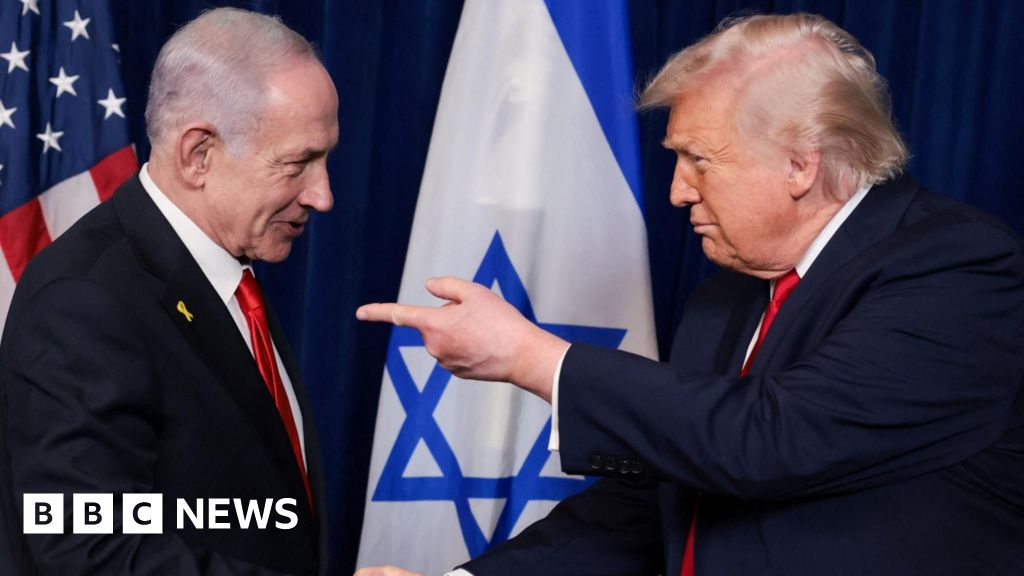

Israeli Prime Minister Benjamin Netanyahu has accepted an invitation to join US President Donald Trump’s Board of Peace.
A statement from his office said that Netanyahu will be a member of the board “composed of world leaders”.
The board was originally believed to be aimed at helping end the two-year war between Israel and Hamas in Gaza and overseeing reconstruction. But its proposed charter does not mention Palestinian territory and seems designed to replace the functions of the UN.
The United Arab Emirates and Bahrain have also agreed to join, as have Albania, Armenia, Azerbaijan, Belarus, Hungary, Kazakhstan, Morocco and Vietnam. Many others expressed reservations.
It is not clear how many countries have been invited to join Trump’s new body – Canada, Russia, Turkey and the UK are among them, but have not yet publicly responded.
Norway said it would not participate because the current proposal “raises too many questions”, while France and Sweden indicated they would do the same.
According to a copy of the charter leaked to the media, member states will be given a renewable three-year term, but they can secure a permanent place if they contribute $1bn (£740m) in funding to the board.
The document states that the Peace Council will be “an international organization that seeks to promote stability, restore credible and lawful governance, and ensure lasting peace in areas affected or threatened by conflict”. It “will carry out such peace-building tasks in accordance with international law”, it added.
Trump will be the chairman but also “separately serve” as the representative of the US. A US official said that the presidency could be held by Trump “until he resigns”, but the incoming US president could choose a new representative.
As chairman, he has “exclusive authority to create, modify or dissolve subsidiary entities as necessary or appropriate to carry out the mission of the Board of Peace”, according to the document.
He will also select “leaders of global stature” to serve two-year terms on an Executive Board that will help deliver the mission of the Board of Peace, US officials said.
Last Friday, the The White House named the seven members of the founding Executive Board. They include US Secretary of State Marco Rubio, Middle East special envoy Steve Witkoff, Trump’s son-in-law Jared Kushner as well as former British prime minister Tony Blair.
Trump also named Nickolay Mladenov, a Bulgarian politician and former envoy to the UN Middle East, as the representative of the Board of Peace in the land of Gaza during the second phase of Trump’s peace plan, which should see the reconstruction and demilitarization of the territory, including the disarmament of Hamas, as well as a complete withdrawal of Israeli forces.
Mladenov will act as a link in a Palestinian technocratic government that will “manage the restoration of core public services, the reconstruction of civil institutions, and the strengthening of daily life”.
A separate Gaza Executive Board would help prop up the technocratic government, according to the White House.
Witkoff, Kushner, Blair, Rowan, Mladenov will serve it with Turkish Foreign Minister Hakan Fidan, Egyptian intelligence chief Hassan Rashad, Qatari strategic affairs minister Ali al-Thawadi, UAE minister of state for international co-operation Reem al-Hashimy, billionaire Israeli real estate developer Yakir Gabay, and Sigrid Kaag and UN special peace process in the Middle East.
On Saturday, Netanyahu’s office said that the composition of the Executive Board in Gaza “is not coordinated by Israel and is against its policy”.
Israeli media said the decision to include representatives of Turkey and Qatar – both of which helped broker the ceasefire that began in October, along with Egypt and the US – took place “in Israel’s head”.
Under the first phase of the peace plan, Hamas and Israel agreed to a cease-fire, an exchange of live and dead Israeli prisoners in Gaza for Palestinian prisoners in Israeli prisons, a partial Israeli withdrawal, and an increase in the delivery of humanitarian aid.
The second phase faced major challenges, where Hamas previously refused to give up its weapons without creating an independent Palestinian state, and Israel did not commit to a full withdrawal from Gaza.
The ceasefire is also weak. More than 460 Palestinians have been killed in Israeli strikes since they began, according to Gaza’s Hamas-run health ministry, while Israel’s military said three of its soldiers were killed in Palestinian attacks during the same period.
The war was triggered by an attack led by Hamas in southern Israel on 7 October 2023, in which about 1,200 people were killed and 251 others were taken hostage.
Israel responded to the attack by launching a military campaign in Gaza, in which more than 71,550 people were killed, according to the territory’s health ministry.