

Ankore Nust Live,BBC Africaand
Lucy Fleming

 Getty Images
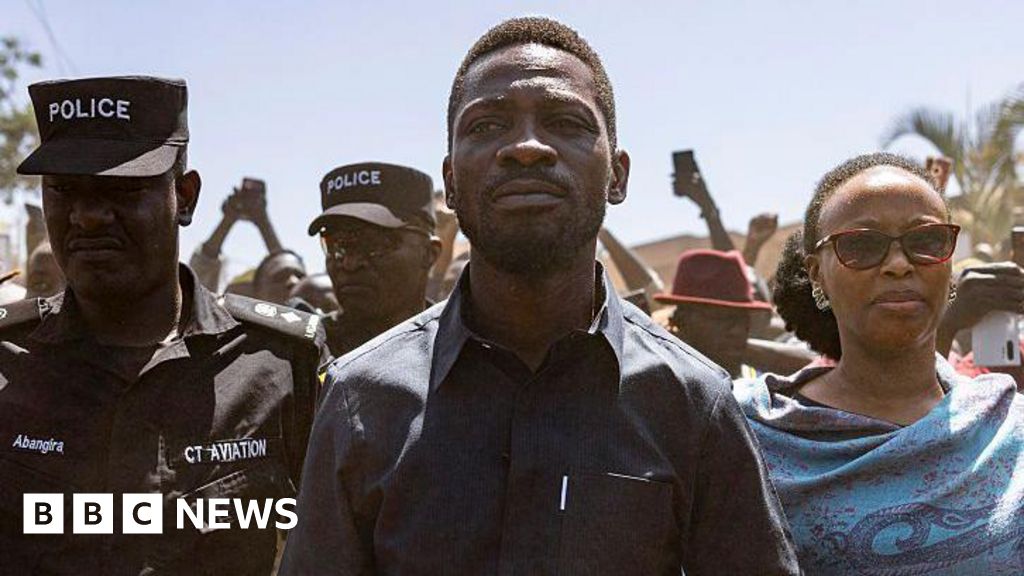
Ugandan police have denied allegations that presidential candidate Bobi Wine was kidnapped on Friday night as vote counting continued in the East African country amid an internet blackout.
Wine’s party said a helicopter landed in the grounds of his home in the capital, Kampala, and forcibly took him to an unknown location.
Wine’s son, Solomon Kampala, initially said his parents had been arrested, but later admitted that his father “escaped” and only his mother was detained, leading to confusion over the opposition leader’s whereabouts.
The latest election figures give Museveni 72% of the vote, with Wine at 24%, based on returns from 94% of polling stations.
Speaking at a press conference on Saturday morning, police spokesperson Kituuma Rusoke said the leader of the National Unity Platform (NUP) party was still at his home in Kampala and that Wine’s family members had been spreading “false” and “baseless” claims.
He said Wine’s movements were restricted because his house was a place of “security interest”.
“We control access to areas that are security hotspots,” Uganda’s Daily Monitor paper quoted him as saying.
“We cannot allow people to use certain places to gather and cause chaos. All our actions are intended to prevent anyone from committing violence or undermining our security,” he said.
On Friday, Wine told his supporters to ignore the “fake results” announced, saying the authorities “stolen the vote”. He did not provide any evidence to support his claim and the authorities did not respond to his allegations.
Wine’s son Solomon Kampala, who has been posting updates on social media, admitted in the evening that he was getting conflicting reports about the security situation at his parents’ home.
“During the raid, my father escaped, my mother was still arrested, she was still not allowed to enter the house,” he posted on X on Saturday morning.
Difficulty accessing the internet in the country makes it difficult for people to verify information.
News that at least seven opposition supporters had been killed in disputed circumstances in Butambala, about 55km (35 miles) southwest of the capital, on Thursday only emerged late on Friday.
The US embassy then issued an alert to its citizens due to reports that security forces “used tear gas and fired in the air to break up the gatherings”.
During Thursday’s voting, voting was delayed by up to four hours at many polling stations across the country because ballot boxes were slow to arrive and biometric machines, used to verify voters’ identities, did not work properly.
Others have linked the problems to network outages.
Electoral chief Simon Byabakama said on Friday that vote counting was not affected by the internet blackout and that the final results would be out before 17:00 local time (14:00 GMT) on Saturday.
Thursday’s election follows an often violent campaign, with President Museveni, 81, seeking a seventh term in office. He first took power as a rebel leader in 1986.
Wine, a 43-year-old pop star-turned-politician, who says he represents the youth of a country where most of the population is under 30, has promised to deal with corruption and impose reforms, while Museveni argues that he is the only guarantee of stability and development in Uganda.
Although there are six other candidates, the presidential poll is a two-horse race between Museveni and Wine.
The campaign season was marred by the disruption of opposition activities – security forces were accused of attacking and detaining Wine’s supporters.
Rusoke, the police spokesman, dismissed these complaints, accusing opposition supporters of being disruptive.
Internet access was suspended on Tuesday, with Uganda’s Communications Commission saying the blackout was necessary to prevent misinformation, fraud and incitement to violence – a move the UN human rights office condemned as “deeply worrying”.

 Getty Images/BBC