
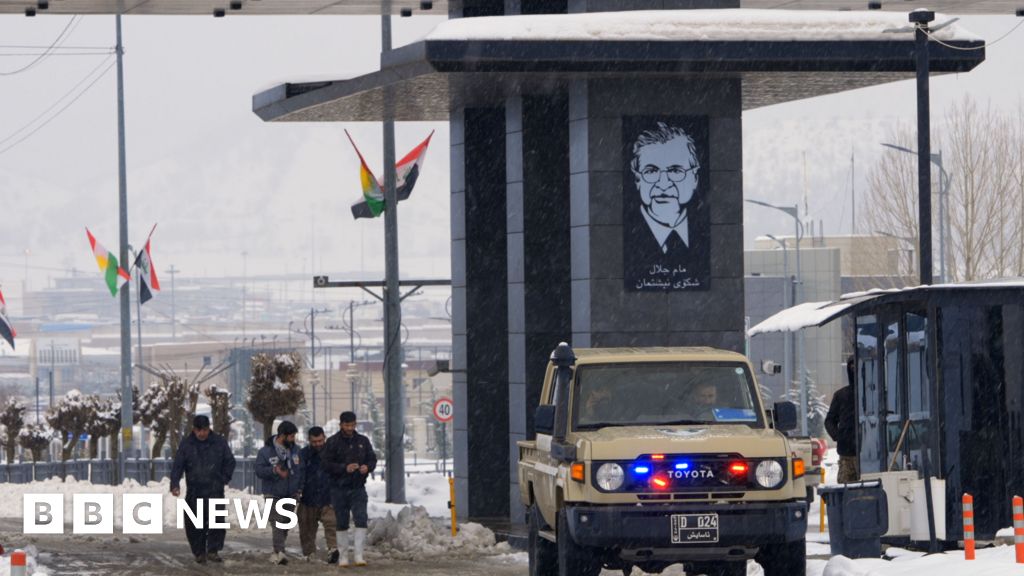

Lucy WilliamsonBashmaq border crossing in Iraqi Kurdistan

 Fred Scott/BBC
At the border crossing from Iran to Iraqi Kurdistan, the stern face of Iran’s former supreme leader, Ayatollah Khomeini, watched the flow of Iranians leaving the territory.
Thick snowflakes confetti the trucks and pedestrians arriving on this remote mountain pass.
Meters away, just beyond the border post, an Iranian flag fluttered in the snow.
Iran has shut down the internet and blocked phone calls to the country, but its borders are still open.
Inside the arrivals hall, we found many men, women and children – many arriving to visit family on the Iraqi side of the border.
No one we met said they fled Iran because of the recent protests and government crackdowns, but one person – who asked us to withhold his identity – told us that he was shot by security forces during a protest in central Iran on Friday.
“I got hit in the face with seven knuckles,” he said, pointing to the many cuts and bruises on his face. “They hit above my eyelid, on my forehead, on my cheek, on my lip, under my ear and on my jaw. I had to use a razor to cut one of the pellets.”
He told us that he was too afraid of arrest to get medical help, and that others who were injured during the government’s pursuit of protesters also avoided treatment, out of fear that security forces would come and arrest them.
“One of my friends told me he was hit by a pellet round,” he told us. “His son, who is 12 or 13 years old, was hit twice in the leg by live bullets. One of the bullets went through a bone marrow. They were afraid to go to the hospital to have it removed.”
The Iranian regime treats these protests as an existential threat. Cracking down on it seems to be working, and protesters are now thought to be mostly staying at home, out of fear of being shot or arrested. Rights groups say at least 2,500 people have been killed.
But many people here tell us that the demonstrations are continuing, at least this week. The protester we spoke to said security forces crushed protests in his own town on Friday, but they continued elsewhere.
“The demonstrations are still going on in Fardis and Malard, and some areas in Tehran,” he said. “My friends were there. We were always on the phone. On Tuesday night, the protests were still going on, but I haven’t had any updates since then.”
Iranians do not need a visa to cross here, and officials say there is regular traffic back and forth.
Another person we spoke to at the border said he was in Tehran on Wednesday, and saw protesters on the street. It was unclear what form the protest took, or how many participated.
The BBC has seen no hard evidence that street protests are still ongoing. Very little footage has surfaced, and the reports we’re hearing now are impossible to confirm. The BBC, along with other international media, is banned from reporting inside Iran.
 Fred Scott/BBC
Government repression largely seems to be working. But the economic problems that caused this crisis did not go away.
A teacher from a town near the border told us that he doesn’t care who the leader is, he just wants the economic situation to improve.
“We don’t want anything more than our basic rights,” he told me. “To own a house, to own a car, to have a normal life. My salary lasts 10 days, and I have to borrow money to cover the rest of the month. It’s terrible.”
I asked about US President Donald Trump, and his threat of military strikes if the regime continues to kill protesters.
“We’re waiting to see what Trump does,” he told me. “Meanwhile, civilians are being killed.”
The force with which Iran’s leaders have crushed this protest shows their weakness. The regional proxy groups they once used as a defense against attack have been weakened by Israel’s war against Hamas and Hezbollah, and the fall of the former Syrian President, Bashar al-Assad.
And the Israeli-US war with Iran last year has depleted its military capabilities, leaving it vulnerable to attack.
Hidden behind this mountainous border, the Iranian regime is reasserting its control.
But hidden behind the repressive control is the growing fear of the Islamic Republic, which cannot meet the most basic demands of the people: protection from foreign attacks, and prosperity at home.
Additional reporting by Samantha Granville and Maad Mohammed