
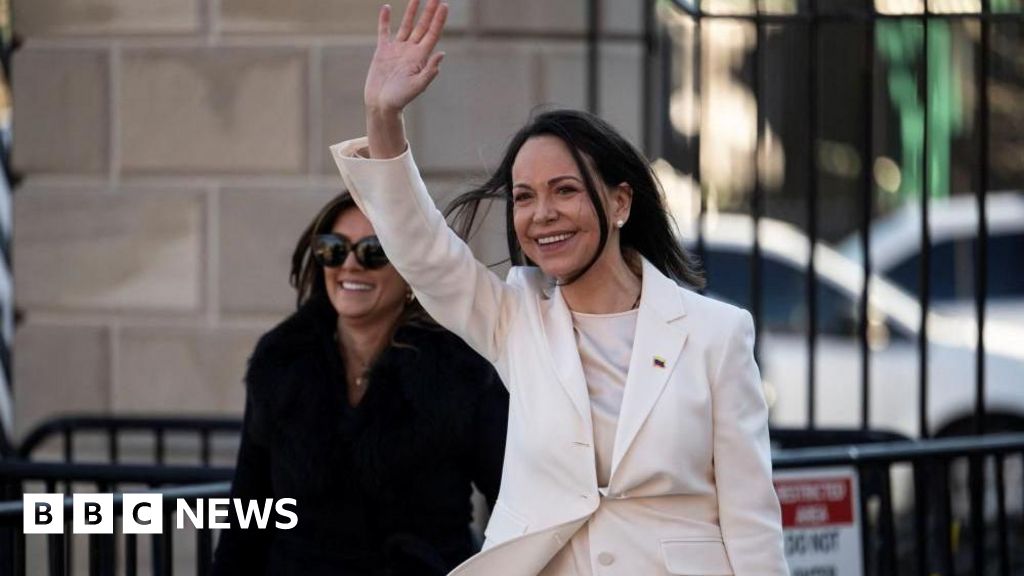

Venezuelan opposition leader María Corina Machado told reporters that she presented the medal for her Nobel Peace Prize to President Donald Trump in a private meeting at the White House on Thursday, but did not say if she accepted it.
“I think today is a historic day for us Venezuelans,” he said after meeting Trump, the first time they had met in person.
In the weeks after US forces seized Venezuelan President Nicolás Maduro in Caracas, Trump refused to endorse Machado, whose movement claimed victory in the 2024 widely contested election, as its new leader.
Instead, he dealt with the acting head of state there, Delcy Rodríguez, Maduro’s former vice-president.
After leaving the White House, Machado spoke to supporters gathered outside the gates, telling them in Spanish, according to the Associated Press: “We can trust President Trump.”
“I presented the president of the United States with the Nobel Peace Prize medal,” Machado later told reporters in English, calling it “a recognition of his extraordinary commitment to our freedom”.
It was unclear whether Trump accepted the award. Trump, who has often spoken about his desire to be awarded the Nobel Peace Prize, expressed anger when it was given to Machado and decided to accept the award last year.
Machado said last week that he would share it with Trump, but the Nobel Committee later clarified that it would not be transferred.
In his remarks, Machado described the story of a military general who fought in the American Revolutionary War who gave a medal to Simon Bolivar, one of the founding fathers of modern Venezuela.
The medal was given “as a sign of brotherhood between the United States, the people of the United States, and the people of Venezuela in their struggle for freedom against tyranny,” Machado said.
“And two hundred years into history, the people of Bolivar are giving back to Washington’s heir a medal – in this case a Nobel Peace Prize medal – as a recognition of his extraordinary commitment to our freedom.”
Machado also visited Congress to meet with US senators during his visit to Washington, where his remarks to reporters were drowned out by supporters chanting “María, presidente” and waving Venezuelan flags.
Machado is expected to use his time with Trump to try to convince him that supporting Rodríguez’s interim government is a mistake, and that his opposition coalition will lead this transition.
White House Press Secretary Karoline Leavitt told reporters as the meeting began on Thursday that Machado was a “remarkable and courageous voice for the majority of the people of Venezuela”.
“The president looks forward to this meeting and expects a frank and positive discussion,” Leavitt said. “He wants to hear directly from Ms Machado about the facts on the ground in Venezuela and what is happening in the country.”
Trump has previously described him as a “freedom fighter”, but has rejected the idea of appointing him to lead Venezuela after Maduro’s ouster, arguing that he does not have enough supplies at home.
Since Maduro’s arrest on January 3, the Trump administration has moved quickly to reform Venezuela’s oil sector, which is under US sanctions. On Wednesday an American official said the US had completed its first sale of Venezuelan oil, worth $500m (£373m).
A Venezuelan government envoy, too, is expected to travel to Washington on Thursday to meet with US officials and take initial steps to reopen the country’s embassy, the New York Times reported.
The emissary is reportedly a close ally and friend of Rodríguez, who has been described as “extremely cooperative” by the White House.
Rodríguez delivered the annual Message to the Nation speech in Caracas on Thursday, where he said he was also willing to attend meetings in Washington.
“If I have to go to Washington as acting president, I will do it tall, walking, and not crawling,” he said, calling on the country to “not be afraid of diplomacy” with the US.
Trump and Rodríguez also spoke by phone on Wednesday, with Trump later describing his counterpart on social media as “a terrible person”. Rodríguez, on the other hand, described the call as “productive and respectful” and characterized by “mutual respect.”