
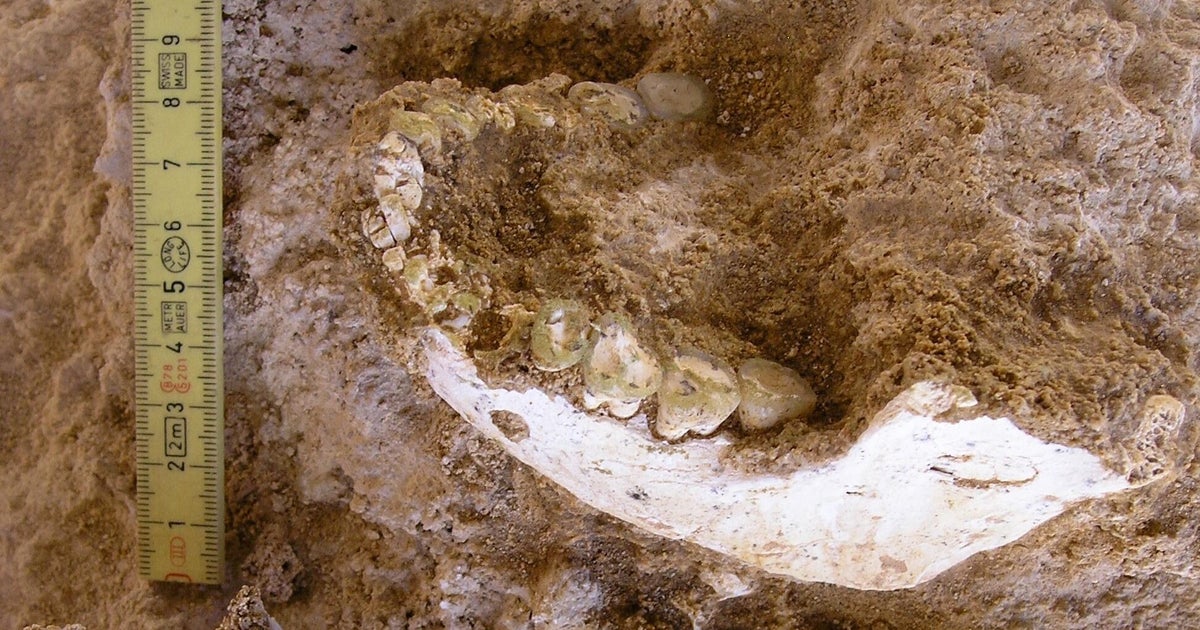

Where did our species first originate? Fossils found more than 773,000 years ago in Morocco reinforce the theory that Homo sapiens first appeared in Africa, scientists said in a study Wednesday.
the oldest Homo sapien fossilsmore than 300,000 years ago, they were found in Jebel Irhoud, northwest of Marrakech.
Our cousin has it Neanderthals it lived mostly in Europe, while the last additions to the family, the Denisovans, roamed Asia.
This has led to an enduring mystery: who was the last common ancestor of Homo sapiens and our cousins, before the family tree split into different branches?
This divergence is thought to have occurred between 550,000 and 750,000 years ago.
Until now, the main hominin fossils from that period were found in Atapuerca (Spain).
They belonged to a species called “Homo antecessor”, about 800,000 years ago, and had characteristics that were a mixture of the older Homo erectus and Homo sapiens and our cousins.
This sparked a contentious debate over whether or not our species originally arose outside of Africa before returning there.
There was a “gap in the African fossil record,” Jean-Jacques Hublin, a French paleoanthropologist and lead author of the study, told AFP.
Research Published in the journal Nature fills this void by finally establishing a firm date for fossils found in 1969 inside a cave in the Moroccan city of Casablanca.
Over the course of three decades, a French-Moroccan team discovered hominin vertebrae, teeth and jaw fragments that have baffled researchers.
Researchers said a thigh bone found in the cave had bite marks suggesting it had been killed or scavenged by a predator. Reuters news agency reported.
“Only the femurs show clear evidence of carnivore modification — flesh and tooth marks — indicating consumption by a large carnivore,” Hublin told Reuters. “However, it appears that the cave was primarily a carcass of carnivores that hominins used only occasionally. The absence of tooth marks on the mandibles does not mean that other parts of the body were not consumed by hyenas or other carnivores.”
JP Raynal, Prehistory Program via Reuters 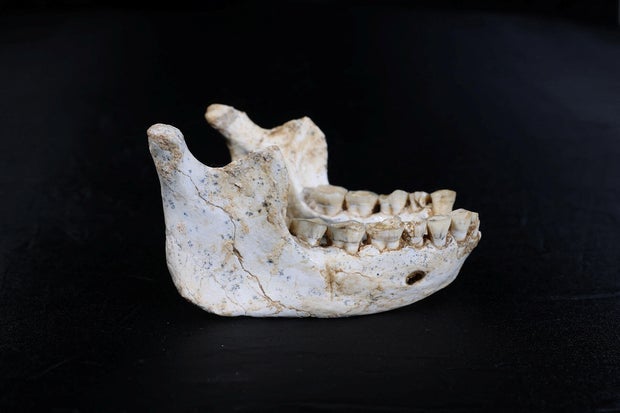
A slender lower jaw discovered in 2008 was particularly surprising.
“Hominins that lived half a million to a million years ago generally didn’t have small jaws,” Hublin said.
“We could clearly see that it was something unusual, and we wondered how old it could be.”
However, many attempts to determine his age remained.
When the earth’s magnetic field was reversed
The researchers then tried a different approach.
Occasionally, the Earth’s magnetic field reverses. Until the last reversals — 773,000 years ago — the magnetic north pole of our planet was close to the geographic south pole.
Evidence of this change is still preserved in rocks around the world.
The Casablanca fossils were found in layers that correspond to the time of that overturning, allowing scientists to set a “very, very precise” date, Hublin said.
This discovery erases the “lack of plausible ancestors” of Homo sapiens in Africa, he added.
Antonio Rosas, a researcher at Spain’s National Museum of Natural Sciences, said it adds to the “increasingly widespread idea” that the origin of our species and the last common ancestor of Homo sapiens and Neanderthals/Denisovars originated in Africa.
“This work also suggests that the evolutionary divergence of the H. sapiens lineage may have started earlier than is commonly believed,” Rosas, who was not involved in the research, said in Nature.
Like Homo antecessor, the Casablanca fossils have a mixture of features of Homo erectus, ourselves and our cousins.
But while they are clearly closely related, the Moroccan and Spanish fossils are not identical, Hublin said, a sign of “populations in the process of splitting and separating.”
JP Raynal, Prehistory Program via Reuters 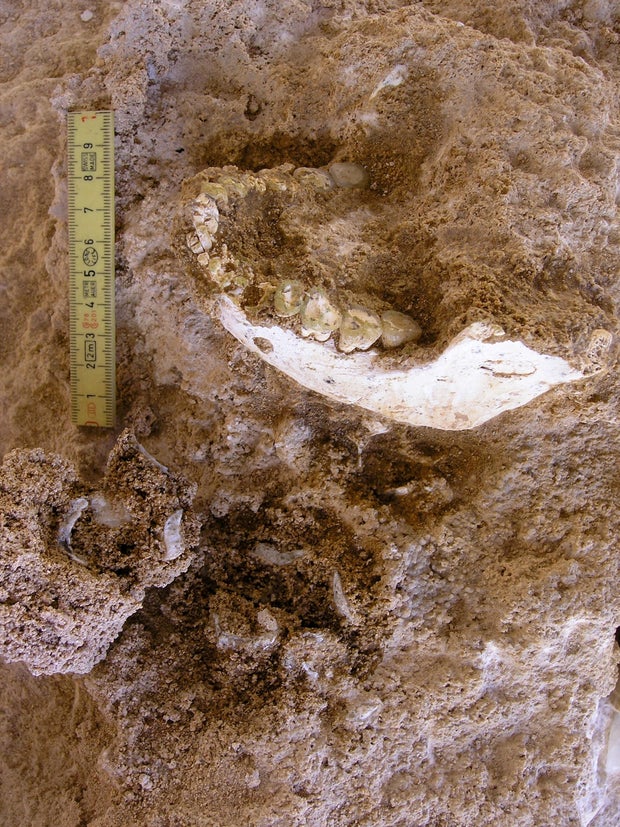
The Middle East is considered to be the main migration route for hominids out of Africa, however, at certain times the sinking of the sea level could have made crossings between Tunisia and Sicily, or crossing the Strait of Gibraltar.
Therefore, the Casablanca fossils are “another piece of evidence in favor of the hypothesis of possible exchanges” between northern Africa and southwestern Europe, said Hublin.
The study was published just weeks after scientists said the newly discovered fossils prove a). Mysterious foot found in Ethiopia It belongs to an ancient unknown relative that lived alongside the famous Lucy’s species.