


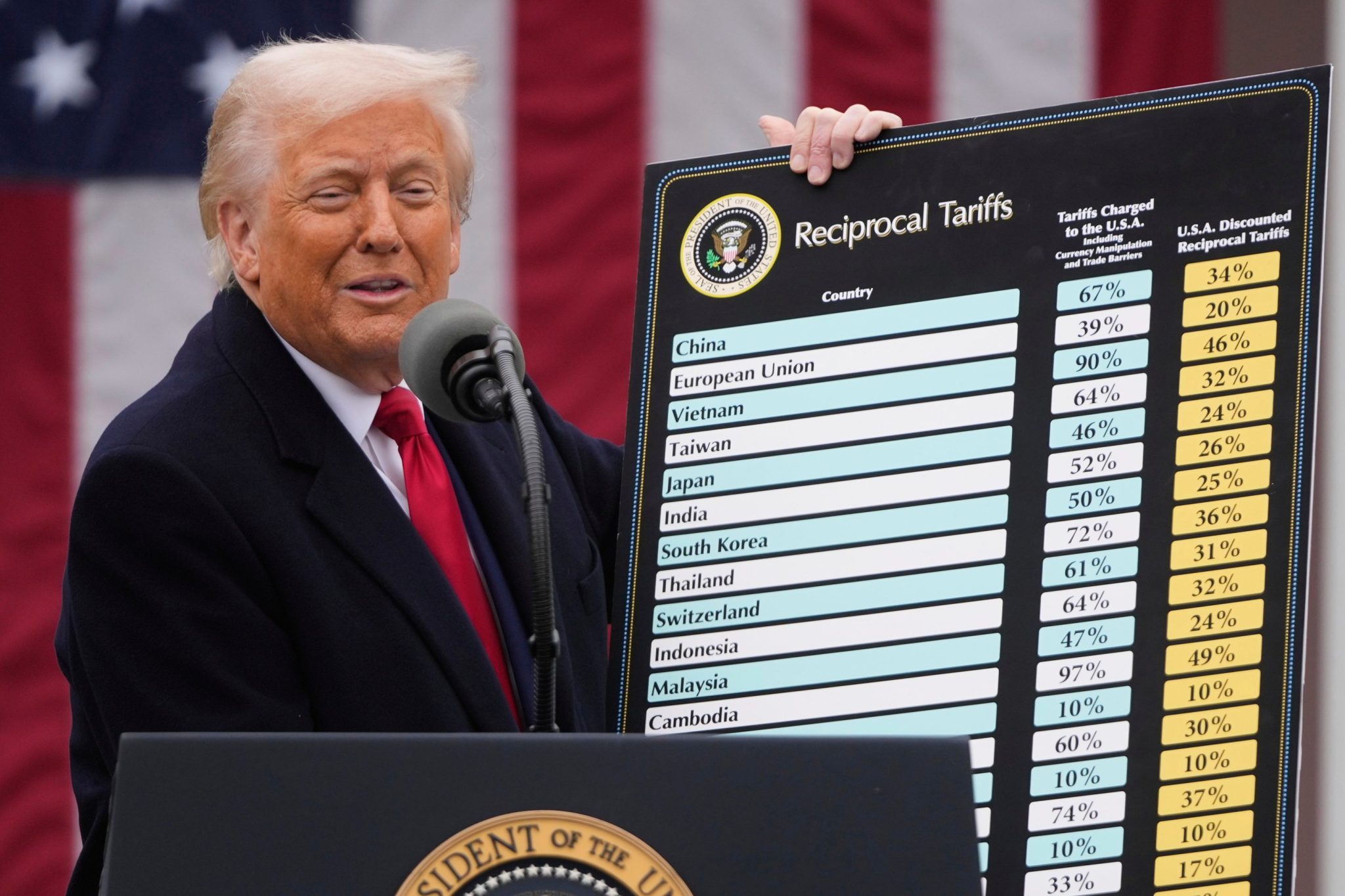
A tariff is a tax levied on you, the consumer. This is an indisputable fact about how tariffs work, they fall on companies, who then typically pass a large portion on to the end consumer. Voters are angry about affordability throughout 2025, culminating in next year’s election, which brings Democrats like New York City’s new mayor Zohran Mamdani to power and an angry President Trump who complains that affordability is a “hoax” when Democrats talk about it because he has beaten inflation since taking office.
But what if tariffs actually reduce inflation?
The widely held “cost push” theory holds that tariffs make imported inputs more expensive, thereby driving up domestic production costs. This will lead to lower economic activity and higher inflation in the short term. A new analysis from the Federal Reserve Bank of San Francisco, a letter titled “What can history tell us about tariff shocks?“This contradicts the long-term economic consensus that tariffs cause inflation. In fact, it claims to have the opposite effect: Higher tariffs will lead to lower inflation (and higher unemployment).
Authors Regis Barnichon and Aayush Singh said in the report: “Our analysis of historical data highlights the possibility that significant tariff increases in 2025 could put upward pressure on unemployment and downward pressure on inflation.”
The consensus cast a pessimistic view on economic conditions after President Donald Trump last year raised the average U.S. tariff rate by 15% from less than 3% at the end of 2024, the highest level since 1935. Yale Budget Lab. If accurate, the San Francisco Fed report offers a glimmer of hope that the tariff hit may not actually increase inflation as much as some economists fear.
The impact of uncertainty on demand
The crux of the argument is that tariff shocks create economic uncertainty, a deflationary mechanism. The report found that tariffs are widely believed to increase inflation but do not take into account the impact of uncertainty on the economy.
“Tariff shocks often coincide with an uncertain economic environment, which itself can reduce consumer and investor confidence, thereby suppressing economic activity and putting downward pressure on inflation,” the authors write.
The article outlines a second explanation, explaining that tariff shocks may trigger asset price declines, suppress aggregate demand, thereby increasing unemployment and lowering inflation.
History shows deflationary effects
Banichon and Singer analyzed data from 1870 to 1913 and the interwar period between World War I and World War II, the latest example of tariff fluctuations on this scale.
Their data showed a “strong negative correlation” between tariff changes and inflation. Data shows that for every 1 percentage point increase in tariffs, inflation will fall by 0.6 percentage points.
Different times, different economies
But as the authors point out, the U.S. economy has changed dramatically since the early 20th century. “Imported inputs now account for a higher share of production than in the past, which means that tariff shocks may be more likely to be inflationary,” the authors note.
Imports in 2024 before Trump imposed tariffs, total About $3.2 trillion. By comparison, in 1929, the year before the Smoot-Hawley Tariff Act, tariffs were raised to about 20%, and imports were $4.4 billion.
“Because many aspects of the economy are different than they were more than a hundred years ago, these historical lessons may not be fully applicable to the current situation,” Banichon and Singh said. First, the last time tariffs of this magnitude were implemented was during the Great Depression, when unemployment was high. achieve peaked at 25%, and GDP dropped by nearly 30%.
This story was originally published on wealth network