

When the U.S. Bureau of Labor Statistics report The most recent measure of consumer price inflation was just 2.7%, which surprised many. this Consensus prediction Wall Street’s ratio was 3.1%.
Ever since President Donald Trump announced the Liberation Day tariffs last April, economists have expected the additional costs of those tariffs to show up in inflation data. After all, the effective tariff on goods imported from China in November 2025 will be as high as 57.6%. According to data from the Peterson Institute for International Economics.
Will this definitely drive up prices for consumers?
No, according to two new studies. Historically, tariffs have not led to major bursts of inflation; Research from the Federal Reserve Bank of San Francisco and Northwestern University shows. This is because importing companies tend to find ways to circumvent tariffs, or because countries negotiate enough compromises and exemptions from tariffs to lower overall rates.
Both studies show that tariffs hurt economic growth and increase unemployment. But in terms of inflation, they were more benign than expected.
In fact, the U.S. government’s revenue from Trump’s tariffs is already declining, according to a Tuesday research note from Pantheon Macroeconomics. This suggests that their impact on inflation will weaken over time. Pantheon data shows tariff revenue peaked at $34.2 billion in October before falling to $32.9 billion in November and $30.2 billion in December.
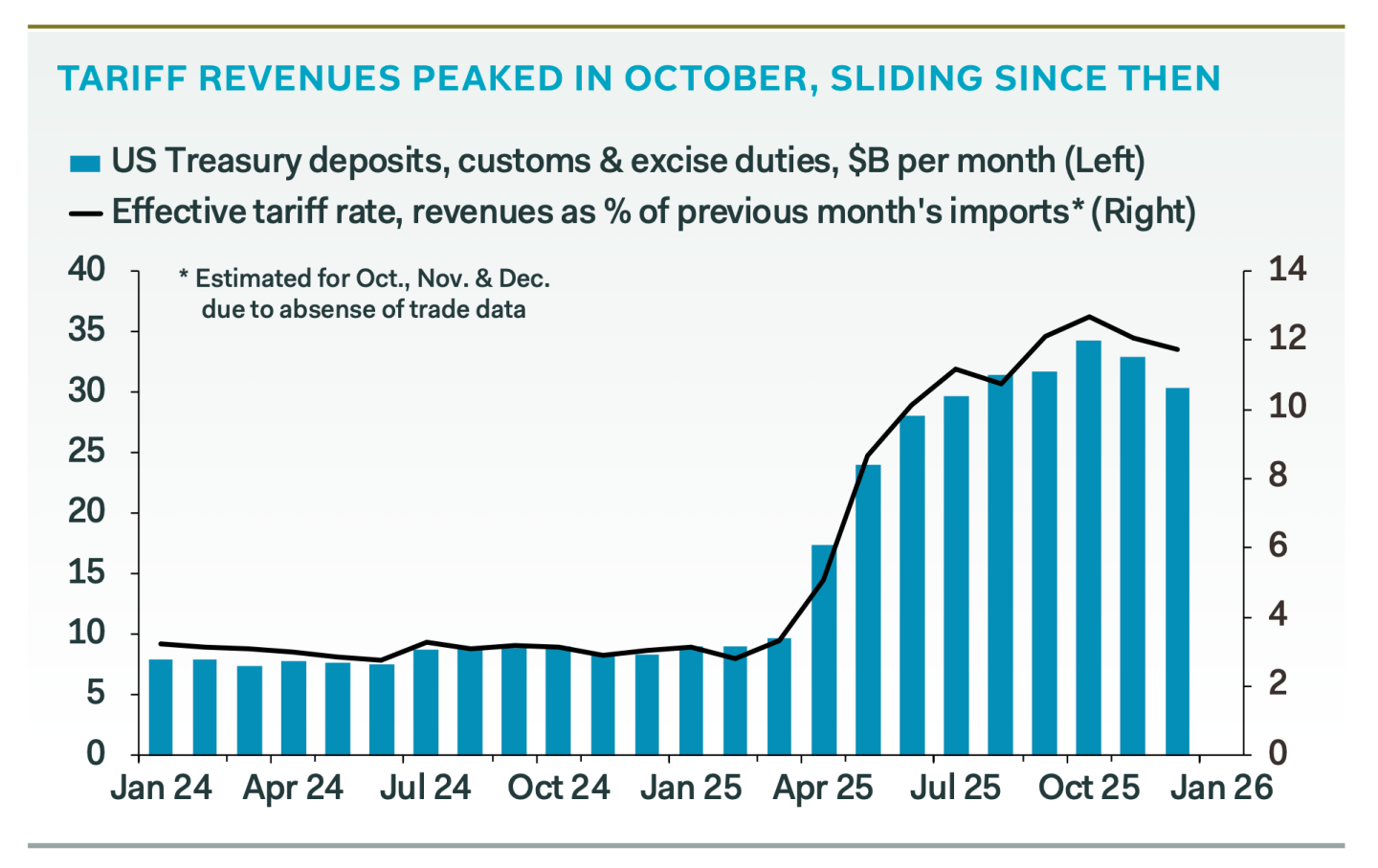
Analysts Samuel Tombs and Oliver Allen told their clients: “The latest trade data is still only for September, but reasonable forecasts in recent months suggest that the average effective tariff rate will be around 12%, which is still well below the level estimated by the independent fiscal watchdog.”
They estimate that the impact on “personal consumption expenditures” (PCE) inflation will only be about 0.9 percentage points, of which businesses will eat up 0.3 percentage points. “Our calculations suggest that this growth had already filtered through 0.4 percentage points by September, so the tariff hit is now largely behind us. As a result, core PCE inflation is likely to move closer to the 2% target later in the year.”
Good for inflation, but good for debt
The lack of tariff revenue has had a knock-on effect on the U.S. government’s ability to address its debt. As Pantheon’s note says, “Revenues are also well below White House expectations; Treasury Secretary Bessent in August predicted that tariffs would increase ‘…well beyond five trillion dollars and possibly as much as one trillion dollars.'”
Independent research shows tariffs so far are well below that level. this Bipartisan Policy Center estimates By 2025, tariffs will increase by $288 billion. Politico magazine placed it $261 billion. this St. Louis Fed Tracker It showed that $331 billion was collected from all production taxes, import taxes and duties in the third quarter of 2025, and the growth of these taxes slowed compared with the previous period.
government Cumulative deficit for fiscal year 2026 According to statistics, (as of October) it has reached $439 billion bipartisan policy center. The total national debt currently exceeds $38.5 trillion.
Trump has used some of the tariff revenue to provide a $1,776 “warrior bonus” to 1.45 million U.S. service members ahead of the Christmas holiday.
A drop in income is also true $1,000 “Trump Account” The president wants to give kids benefits, and there’s an unfulfilled suggestion that he might also give every citizen a $2,000 bonus from the tariffs.
U.S. Treasury yields, which measure the premium investors demand for the risk of lending to the U.S. government, have risen over the past three months. this 5-Year Treasury Bond Yield It rose to 3.727% today from a low of 3.55%. this 10-year yield It rose to 4.187% today from a low of 3.95%. The increases represent a slight increase in investor doubts about the government’s ability to finance its debt.
However, equity investors appear to be quite pleased with the lack of inflation and the apparent reduction in the risk of future inflation. The S&P 500 closed up 0.64% yesterday, less than 1% from its all-time high. Futures are flat this morning. Bitcoin appears to be holding above $93,000 as trading volumes rise across Europe and Asia this morning.
Here’s a snapshot of the market ahead of the opening bell in New York this morning:
- S&P 500 Index Futures This morning was mediocre. It closed up 0.64% on the previous trading day.
- Stoxx Europe 600 Index Prices were unchanged in early trade.
- British FTSE 100 It rose 0.59% in early trading.
- Japanese Nikkei 225 Index up 1.32%.
- Chinese CSI 300 up 1.55%.
- South Korea Korea Composite Index up 1.52%.
- Indian nifty 50 Down 0.28%
- Bitcoin rose to $93,500.